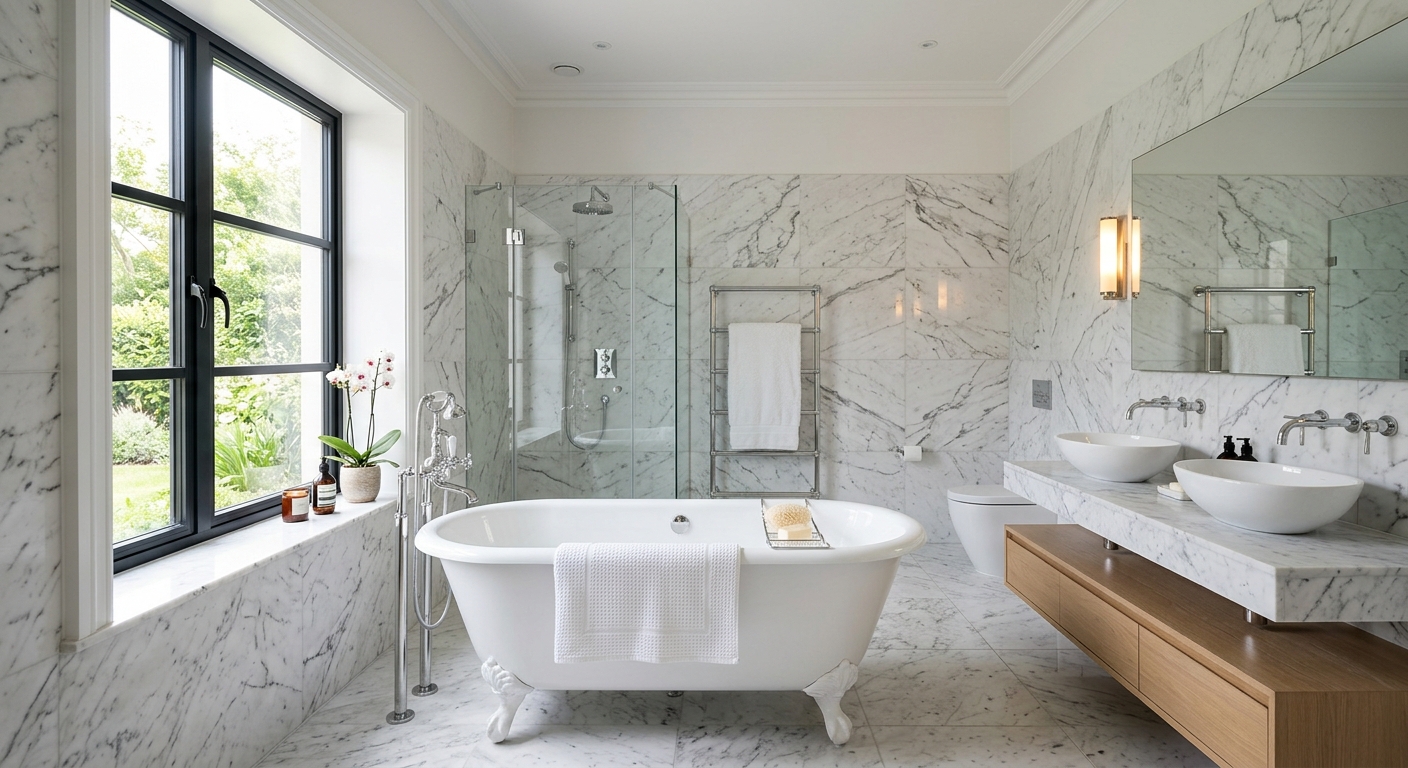
Bathroom renovation options and costs in Mount Olive-Silverstone-Jamestown
Bathroom renovation in Mount Olive-Silverstone-Jamestown is shaped by the realities of GTA trades pricing and by what’s already inside your walls. The area’s housing mix is heavily influenced by post-war and 1960s–1970s homes, and Toronto’s broader urban stock means dated plumbing layouts are common—often with cast-iron or undersized drains lurking behind finishes. With a local population of 32,954 (Statistics Canada, 2021 Census), demand for skilled bathroom crews is steady, especially around busy commuter corridors where homeowners time work between seasons and take advantage of contractor availability.
Prices in the Toronto economic region don’t swing as much from “weather” as they do from labour costs and the age of the home. While we don’t price bathrooms because of freezing winters the way we might for an exterior project, humidity and temperature swings still matter: waterproofing and ventilation choices directly affect long-term mould and grout failure risk. In older homes, once we open up floors and walls, we frequently find galvanized or undersized supply lines, older venting that doesn’t meet modern expectations, and sometimes asbestos-containing materials in older tile or drywall compounds. These discoveries can move a “cosmetic” plan into a full renovation scope.
For example, in the Silverstone area, bathroom trades tend to be in high demand as homeowners refresh aging owner-occupied properties and rental units. The takeaway is simple: your final budget depends on how much hidden work gets uncovered. Below is a practical way to compare scopes before you request itemised quotes for your specific bathroom.
| Renovation Scope |
What's Included |
Typical Duration |
Price Range |
| Cosmetic refresh (paint, fixtures, accessories only) |
New vanity or taps, toilet/trim swaps (no moving plumbing), paint, accessories, caulking and resealing, light hardware updates |
3–7 days |
$4,000–$8,500 |
| Mid-range full renovation (new tile, vanity, tub/shower, electrical) |
Demo and disposal, tub/shower or surround replacement, new vanity and mirror, vent fan upgrade, select electrical (GFCI/exhaust), tile floor + walls, updated shut-offs where needed |
2–4 weeks |
$12,000–$20,000 |
| High-end full renovation (custom tile, steam shower, heated floors) |
Custom shower system with premium waterproofing, heated floors, designer vanity and fixtures, frameless glass where applicable, upgraded plumbing/venting as required, more complex tile layout |
3–6 weeks |
$20,000–$30,000 |
| Shower-only installation (convert tub to walk-in shower) |
Remove tub, install walk-in shower (tile or prefab base), new valve trim, waterproofing system, glass door or enclosure, reconnect drain/venting adjustments as discovered |
2–3 weeks |
$8,000–$18,000 |
| Bathtub replacement or tub-liner install |
Swap tub and finishes (or install tub liner where suitable), re-caulk and seal, minor plumbing adjustments, new surround panels/trim, paint touch-ups |
5–10 days |
$1,200–$3,500 |
| Tile-only installation (floor + surround, existing layout kept) |
Tile removal and re-set, floor + wall tiling, backer/waterproofing as required, grouting and finishing, no plumbing relocation |
1–3 weeks |
$3,000–$10,000 |
Prices are estimates only and vary by project scope, site access and material selection.
What affects the price of bathroom renovation in Mount Olive-Silverstone-Jamestown
In the Toronto economic region, two homeowners can receive quotes that differ by 30–50% for what looks like the same bathroom—because the labour and “unseen” scope are rarely identical. Toronto’s skilled trades command premium hourly rates, and bathroom work is inherently labour-intensive: removing old tile, re-plumbing within walls, waterproofing carefully, and then setting tile to tolerances that prevent leaks and lippage.
Just as importantly, the age of the home drives cost more than climate does. Older post-war and 1960s–1980s houses commonly have cast-iron or undersized drain stacks, galvanized supply lines, and ventilation that doesn’t meet current expectations. When we open up the bathroom, we sometimes need to bring rough plumbing and venting up to current Ontario code, which can mean several thousand dollars for drain reconfiguration, vent corrections, and new shut-offs. And if we discover asbestos in older vinyl floor tile or related materials (more typical in pre-1985 builds), abatement isn’t optional—budgets can jump by about $1,500–$5,000+ depending on how much material is affected.
In Mount Olive-Silverstone-Jamestown, I often see cost rise when the tub-to-shower conversion requires drain slope changes or when the subfloor is uneven and we must correct for proper membrane adhesion. Costs can also drop when a “tile-only” scope keeps the layout intact—no moving drains or supply lines—keeping labour focused on waterproofing and installation. As a baseline, many full renovations land in the $12,000–$30,000 range, while shower-only conversions often sit higher per square foot because demolition and plumbing adjustments are bundled with the tile work.
The key is that hidden conditions decide the final line item totals: the more unknowns behind the finishes, the more your project behaves like a mid-range to high-end full renovation rather than a cosmetic refresh.
| Price Factor |
Why It Matters |
Cost Impact |
| Layout change — moving drain or supply lines requires rough-in work |
Additional demo, framing access, plumbing rough-in, and often venting/shut-off updates |
Typically +$2,000–$8,000 depending on distance and complexity |
| Tile selection — large-format porcelain vs. mosaic vs. ceramic |
Harder materials, more precise cutting, and different setting methods affect labour time and waste |
Typically +$1,000–$5,000 |
| Fixture tier — builder-grade vs. mid-range vs. designer brands |
Higher-end trims, valves, and shower systems cost more and may require additional accessories |
Typically +$500–$4,000 |
| Subfloor condition — rot or unlevel concrete adds scope |
Repairs and re-building change waterproofing performance and tile flatness requirements |
Typically +$800–$4,500 |
| Electrical — adding GFCI outlets, exhaust fan, heated floor circuit |
Licensed work and sometimes panel or wiring updates drive both labour and parts |
Typically +$500–$3,500 |
| Waterproofing method — membrane type and extent |
Better membranes and correct coverage reduce leak risk in Ontario’s bathroom humidity |
Typically +$400–$2,500 |
| Older-home surprises — asbestos tile, cast-iron drains, galvanized pipes |
Abatement and plumbing upgrades are time-consuming and can trigger additional inspections |
Typically +$1,500–$10,000+ |
| Bathroom size — sq ft drives tile and labour time directly |
More surface area means more tile, thinset, labour hours, curing time, and finishing |
Typically +$500–$5,000 by size |
Permits & regulations in Ontario
In Ontario, many bathroom updates are considered cosmetic and typically don’t require permits—especially when you’re not changing the building’s systems. Swapping fixtures such as a toilet, vanity, taps, or replacing an existing tub/shower trim with the same configuration usually falls into the “finish update” category. Repainting, replacing accessories, and doing in-kind retiling with the same layout generally don’t trigger a permit either.
Where permits and inspections often become necessary is when you change how the bathroom works, not just how it looks. If you relocate plumbing—meaning moving a drain or supply lines, changing valve locations, or reconfiguring the shower/tub footprint—expect a permit requirement for the rough-in work and an inspection before close-up. If you add an exhaust fan and run new wiring, you’ll need licensed electrical work; electrical must meet provincial code, and your electrician should handle the permit process where required. Structural wall changes, changes that affect load-bearing elements, or any major alterations also typically require permits.
For Mount Olive-Silverstone-Jamestown homeowners, verify contractors in three steps: (1) confirm the contractor’s Ontario trade licence (for plumbing/electrical work, the licence belongs to the tradesperson/company doing the regulated work), (2) request a Certificate of Insurance and ensure it includes liability coverage and coverage dates, and (3) ask for proof of WSIB/WCB coverage (or the equivalent clearance letter your contractor can provide). Then match the document names to the legal entity on the quote and invoice—don’t rely on a brand name alone.
Choosing tile, waterproofing and fixtures for your Mount Olive-Silverstone-Jamestown bathroom
When budgeting for a bathroom renovation in Mount Olive-Silverstone-Jamestown, three material decisions usually determine both your cost and your long-term performance: tile type, waterproofing system, and fixture tier. In Ontario’s bathrooms, ventilation and waterproofing aren’t optional extras—they’re the difference between a bathroom that stays tight for years and one that develops mouldy grout lines and hidden moisture damage.
Tile choice: ceramic is typically your entry point, but it can be more prone to visible wear depending on finish and traffic. Porcelain is denser and generally holds up better for floors and wet-area walls, while natural stone (marble, travertine, slate) can look exceptional but often brings higher material costs and more labour for finishing, sealing, and layout. Installation complexity rises with stone tolerances and premium finishes—so sometimes a “cheap-looking” tile turns out expensive because it demands more labour to achieve the same result.
Waterproofing method: paint-on membranes are usually for small, straightforward areas; bonded sheet membranes and specialist systems (including those that integrate with a defined shower pan approach) provide more robust protection when installed correctly. The right system—properly lapped, sealed at corners, and matched to the shower design—reduces moisture intrusion when humidity spikes.
Fixture tier: builder-grade fixtures keep your $12,000–$20,000 full-reno budget more controllable, while mid-range and designer valve/shower components can push you toward the upper $20,000–$30,000 band mainly through parts cost and sometimes valve rough-in complexity.
Where a price difference is justified: paying more for porcelain tile and a proven waterproofing approach is usually worth it in a Toronto-area home where older plumbing and ventilation conditions can increase daily humidity. Where it may not be: chasing natural stone everywhere instead of using it for a feature wall or niche can keep your budget working for the parts that prevent leaks.
| Material / Option |
Pros |
Cons |
Price Range |
| Ceramic tile (floor + walls) |
Good entry price, wide style selection, familiar installation methods |
Less dense than porcelain; can show wear in high-traffic zones; may require careful selection for slip resistance |
$3,000–$6,500 |
| Porcelain tile (floor + walls) |
Durable for wet areas, better stain resistance, cleaner look with fewer replacements long-term |
More expensive material; large-format porcelain can increase cutting and labour time |
$5,000–$10,000 |
| Natural stone (marble, travertine, slate) |
High-end aesthetics; unique veining; premium feel |
Requires sealing/maintenance; higher install labour and potential for chipping; may need more subfloor prep |
$8,000–$18,000 |
| Frameless glass shower enclosure |
Modern look; easier visual clean-up than heavier enclosures |
More costly hardware; requires accurate tile plane and solid framing for proper alignment |
$2,000–$6,500 |
| Prefab tub surround (acrylic) |
Fast install; fewer tile-setting variables; easy maintenance |
Limited style/colour range; can look less “custom”; careful sealing required at transitions |
$1,200–$3,500 |
| Custom shower pan (tile or linear drain) |
Best long-term water management when built correctly; sleek linear drain options |
Labour intensive; requires precise slope and waterproofing detailing; higher material and niche fabrication |
$4,000–$12,000 |
How to choose a bathroom renovation contractor in Mount Olive-Silverstone-Jamestown
Choosing a contractor is where Mount Olive-Silverstone-Jamestown homeowners win or lose time and money. Start with licensing and coverage: for regulated trades, confirm the Ontario trade licence for the installer performing the work (plumbing and electrical must be handled by licensed parties). Ask for a Certificate of Insurance showing liability coverage; it should list the named insured and show valid dates for the period of work. Next, verify WSIB/WCB coverage—either via proof of coverage or a clearance letter your contractor can provide on request.
Then get 2–3 itemised written quotes. The best quotes separate labour and materials (demo, framing, waterproofing, tile setting, plumbing rough-in, electrical, disposal), and they state assumptions clearly. Avoid “lump sum only” quotes when the scope is complex—especially for tub-to-shower conversions where drain re-slope or vent correction can appear once walls come open.
Read the scope line-by-line: are permits included or extra? Is disposal included? What’s excluded (subfloor repairs, venting corrections, asbestos abatement, changes to bathroom size, backer replacement)? A reliable contractor will specify inclusions and exclusions rather than leaving them to change orders.
Warranty matters too. Look for a workmanship warranty length (and what it covers), plus manufacturer/product warranties for showers, membranes, and fixtures. Ask whether warranties are transferable to you as the homeowner. Finally, payment schedule: never pay more than about 10–15% upfront. Use a holdback until the work is complete and verified. Get the start date and completion estimate in writing so the plan matches reality in the GTA’s busy trade calendar.
- Confirm Ontario trade licensing for each regulated trade involved
- Request proof of liability insurance with valid dates
- Verify WSIB/WCB coverage via clearance letter or proof
- Insist on itemised quotes: labour + materials, not just totals
- Confirm whether permits are included in the quoted price
- Ask what disposal/recycling is included (demo materials, packaging)
- Review exclusions: subfloor repairs, venting updates, asbestos/abatement
- Get the waterproofing method named (membrane type and where it’s applied)
- Ask about tile substrate prep (backer/underlayment, flattening requirements)
- Confirm schedule: start date, milestone dates, and completion estimate
- Check warranty: workmanship duration and manufacturer warranty details
- Use a payment schedule with a holdback until completion inspection
Red flags I see in Mount Olive-Silverstone-Jamestown include contractors who won’t provide insurance/WSIB details, vague scope wording that pushes changes into the final invoice, offers to “skip waterproofing prep” to save time, requests for large upfront deposits beyond 10–15%, and no written timeline or no named product warranties for shower membranes and critical water-bearing components.
Frequently asked questions — bathroom renovation in Mount Olive-Silverstone-Jamestown
What's the most common mistake homeowners make in bathroom renovations?
In Ontario, the most common mistake I see in Mount Olive-Silverstone-Jamestown is planning for a “looks-only” renovation and then getting surprised by plumbing and waterproofing scope once walls and floors are opened. Many homeowners assume they can keep costs near a cosmetic refresh level, but if the home has older venting, undersized drains, or galvanized supply lines, the job often shifts toward a mid-range full renovation. That can move budgets from a refresh closer to the $4,000–$8,500 band into the $12,000–$20,000 band quickly. The fix is simple: insist on itemised quotes, include allowance lines for discovered conditions, and choose a contractor who explains waterproofing and rough-in assumptions clearly before demolition.
How long does tile installation take in a Mount Olive-Silverstone-Jamestown bathroom?
Tile timelines depend on bathroom size, tile type, and how much substrate prep is required. In Mount Olive-Silverstone-Jamestown, a typical floor + wall tile package usually takes about 5–10 working days of installation time, plus drying/curing and grouting time. If you’re using large-format porcelain or doing a custom shower surround, plan on longer because cutting, layout, and achieving flatness take more labour. Also remember the sequencing: waterproofing installation and curing come before tile setting. So, even if tile “on the wall” looks fast, the overall renovation schedule still includes prep, membrane work, and cure times. This is why tile-only scopes are often quoted in the same general timeframe as part of a full renovation, rather than as a weekend project.
How much does a bathroom renovation cost in Mount Olive-Silverstone-Jamestown?
For Mount Olive-Silverstone-Jamestown homeowners, realistic full bathroom budgets in the Toronto economic region typically fall in the $12,000–$30,000 range, mainly due to GTA labour rates and the age of local housing stock (which affects plumbing rough-in and ventilation scope). If you’re doing a full renovation with new tile, a tub/shower or shower replacement, and electrical updates, many projects land in the middle of that range. Cosmetic refreshes are commonly much lower, but they only work when you don’t need to move drains, add exhaust fan circuits, or address subfloor issues. Shower-only conversions usually cost more than you’d expect per day of work because demolition and plumbing adjustments are labour-heavy. Always budget a contingency for older-home surprises like cast-iron drains, galvanized pipes, or potential asbestos-containing materials in pre-1985 finishes.
How long does a bathroom renovation take in Mount Olive-Silverstone-Jamestown?
Most bathroom renovations in Ontario—especially in the Toronto economic region—take longer than homeowners expect because of trade scheduling, curing times, and the possibility of hidden conditions. A cosmetic refresh can often be completed in about 3–7 days. Mid-range full renovations typically take 2–4 weeks, while higher-end custom showers and heated flooring can run closer to 3–6 weeks. Shower-only conversions usually land around 2–3 weeks depending on whether drain slope/venting needs rework. The biggest timing drivers are subfloor correction, waterproofing cure requirements, and when plumbing/electrical rough-in inspections are needed. If your home is older, factor in additional time for potential abatement or electrical/plumbing updates once walls are open.
Do I need a permit for a bathroom renovation in Ontario?
In Ontario, cosmetic changes generally don’t require a permit—think swapping fixtures like taps, toilets, and vanities, replacing finishes, or retiling without relocating plumbing. However, if you relocate plumbing (moving drains or supply lines), add or change electrical circuits for things like a new exhaust fan or heated flooring, or make structural changes, permits and inspections are commonly required. Licensed electrical work must meet provincial code and is typically tied to permitting/inspection where applicable. For Mount Olive-Silverstone-Jamestown homeowners, the practical step is to ask the contractor to state which work is permit-bound in writing before signing. If a contractor can’t explain what requires a permit versus what doesn’t, that’s a sign they’re not planning properly for inspections and code compliance.
What's the best tile for a bathroom in Mount Olive-Silverstone-Jamestown?
The “best” tile depends on where it’s installed and how you want the bathroom to perform long-term in Ontario humidity. For most homeowners in Mount Olive-Silverstone-Jamestown, porcelain is a top choice for floors and wet-area walls because it’s dense, durable, and typically more resistant to staining and wear than basic ceramic. Ceramic can still be a good value, but it’s important to select the right finish for slip resistance and to ensure correct substrate prep. Natural stone looks luxurious, but it often needs sealing and more careful maintenance. If you’re cost-conscious, porcelain tends to deliver the best balance of performance and budget, often aligning with the middle of the tile-only ranges. Whatever you choose, the real determining factor is the installation system: correct waterproofing, proper substrate, and careful grout/water-bearing detailing matter as much as the tile name.