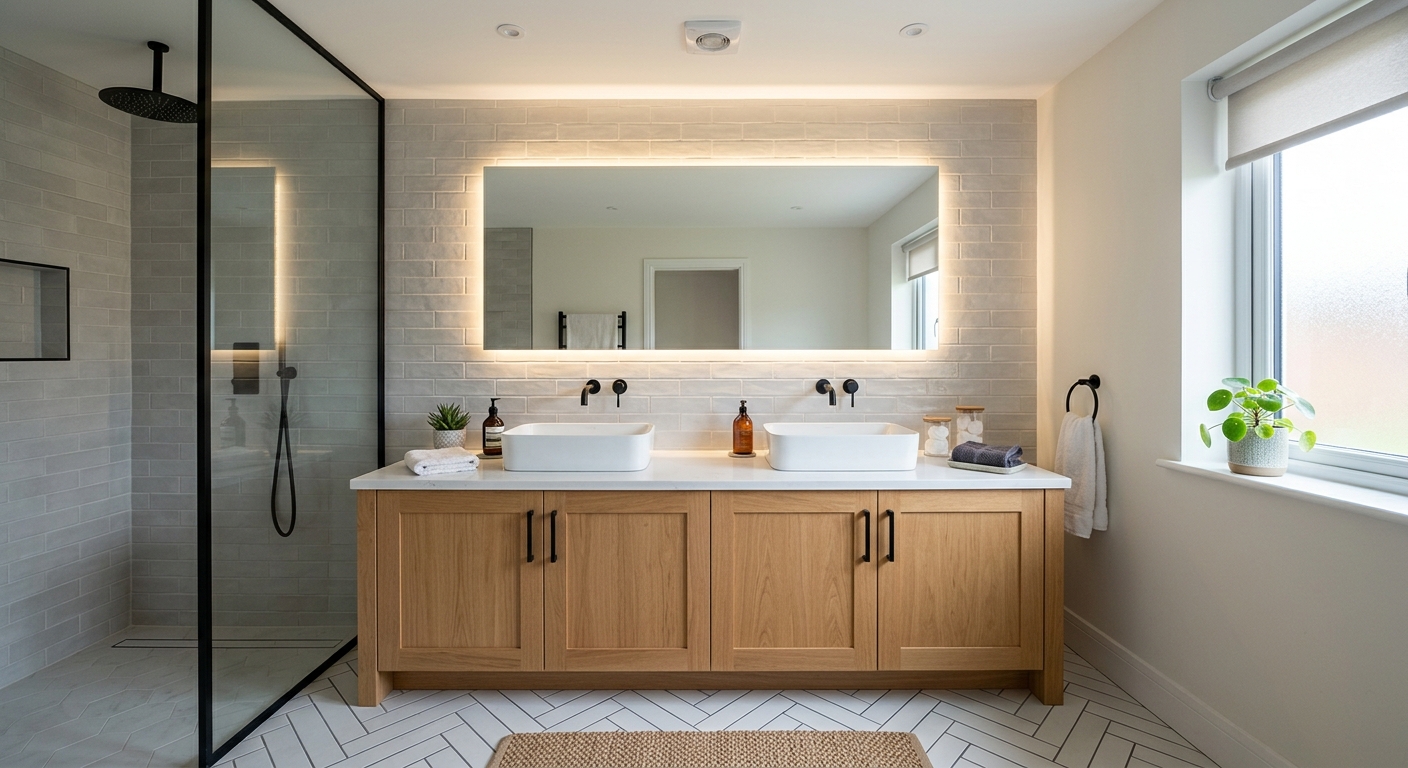
Bathroom renovation options and costs in Prince Rupert
Prince Rupert bathroom renovations run the gamut—from quick cosmetic refreshes to full gut remodels—but the “right” option usually depends on how old your home is and what’s hiding behind the walls. In Prince Rupert, the housing stock is notably mature: with 75.3% of homes built before 1981 (Statistics Canada, 2021 Census), many bathrooms start with dated plumbing layouts, older venting routes, and drains that can be nearing end-of-life. In those conditions, you’re more likely to uncover issues such as cast-iron drain sections, aging supply lines, or floor finishes that may contain asbestos in older assemblies, which can pause work and expand scope.
On the North Coast, costs are shaped primarily by regional labour rates and the amount of “in-wall” troubleshooting required, rather than local weather alone. Coastal humidity in British Columbia demands top-tier waterproofing and ventilation, and when exhaust ducting or fan wiring needs upgrades, timelines can tighten or budgets can climb. Trade availability can also affect scheduling; in practice, contractors often do see the highest demand in the older neighbourhood pockets near the downtown core and the East Beach area, where many houses are mid-century and renovations uncover surprises behind original finishes.
To compare realistic outcomes, use the table below as a starting point for your quote range—then budget for contingencies, especially in pre-1981 homes.
| Renovation Scope |
What's Included |
Typical Duration |
Price Range |
| Cosmetic refresh (paint, fixtures, accessories only) |
New vanity or sink, toilet/trim swap (no plumbing move), paint, re-caulk, towel bar/toilet paper holder, basic hardware, minor surface repairs |
3–7 days |
$5,000 – $9,500 |
| Mid-range full renovation (new tile, vanity, tub/shower, electrical) |
Removal and disposal, new vanity, tub/shower valve updates, tile floor + tub surround, waterproofing and membranes, exhaust fan, GFCI (as required), upgraded lighting (where needed), permit/inspection handling if scope triggers it |
2–4 weeks |
$18,000 – $30,000 |
| High-end full renovation (custom tile, steam shower, heated floors) |
Higher-end tile and grout detailing, custom shower system with premium waterproofing, heated floor circuit and controls, frameless glass (if applicable), upgraded valves and fixtures, more extensive electrical scope, enhanced ventilation strategy |
4–6 weeks |
$30,000 – $45,000 |
| Shower-only installation (convert tub to walk-in shower) |
Remove tub, modify drain/valve rough-in as needed, build walk-in shower with waterproofing, tile surround or pan, glass enclosure options, new exhaust fan if required |
2–4 weeks |
$12,000 – $22,000 |
| Bathtub replacement or tub-liner install |
Remove and replace tub (or install liner where appropriate), re-seal and re-caulk, update trim/valve faceplate, patch tile/finishes at tie-in points |
1–2 weeks |
$3,000 – $7,500 |
| Tile-only installation (floor + surround, existing layout kept) |
Tile demo and install (with waterproofing updates as needed), grout and sealants, substrate prep, minor trim transitions; fixtures kept if they’re serviceable |
1–3 weeks |
$8,000 – $16,000 |
Prices are estimates only and vary by project scope, site access and material selection.
What affects the price of bathroom renovation in Prince Rupert
In Prince Rupert and across the North Coast, the same-looking bathroom job can land 30–50% apart once you price in labour, hidden conditions, and how much “behind the wall” work is required. The big driver is that regional labour rates and trade availability here often make up a large share of the budget, and the age of local housing stock determines how much time it takes to do everything to code—not just what you can see. With 75.3% of homes built before 1981 (Statistics Canada, 2021 Census), you’ll commonly see older drain stacks, older supply piping, and ventilation that doesn’t perform like modern bathrooms.
Older-home realities matter financially. For example, discovery of asbestos-containing floor tile or old drywall compound can require proper abatement steps, which can pause the schedule and add roughly $1,500–$5,000+ depending on extent and how surfaces are sealed off. In bathrooms with minimal ventilation, adding or upgrading an exhaust fan and duct route is another common scope expansion—especially when you’re also upgrading electrical for a safer, modern setup.
Two concrete examples from Prince Rupert: first, if your tub surround is tile over an aging substrate, “tile-only” turns into substrate replacement once the installer checks for flexing or rot. Second, if you’re keeping the plumbing layout but switching to a larger-format porcelain tile, you may reduce grout lines but increase substrate prep time and mortar performance requirements. Those choices can push a project from a realistic band like $15,000–$35,000 for full renovations into the upper end when electrical and waterproofing details become more involved, particularly in older homes.
While the coastal climate increases humidity risk, the cost jump you feel day-to-day is usually from labour-intensive problem solving: rough-in upgrades, careful waterproofing preparation, and the trades needed to get the work inspected and signed off.
| Price Factor |
Why It Matters |
Cost Impact |
| Layout change — moving drain or supply lines requires rough-in work |
New plumbing rough-in means chasing joists/walls, cutting and patching, and additional inspections |
Often adds 20–40% to labour and trades on that scope |
| Tile selection — large-format porcelain vs. mosaic vs. ceramic |
Harder materials, more precise cuts, and substrate tolerance affect labour time and waste |
Typically adds $2,000–$6,000 depending on sizes and complexity |
| Fixture tier — builder-grade vs. mid-range vs. designer brands |
Higher tiers cost more and may require specific valves/trim compatibility |
Often $500–$4,000 difference plus possible added trim labour |
| Subfloor condition — rot or unlevel concrete adds scope |
Fixing movement and leveling is essential for tile and waterproofing durability |
Commonly adds $1,000–$7,000+ when plywood/boards or prep is extensive |
| Electrical — adding GFCI outlets, exhaust fan, heated floor circuit |
More circuits and proper ventilation wiring increase time and licensed electrician involvement |
Often adds $800–$3,500+ |
| Waterproofing method — membrane type and extent |
Correct system coverage reduces leak risk; more robust systems require more detailing work |
Often adds $600–$2,500 compared with basic approaches |
| Older-home surprises — asbestos tile, cast-iron drains, galvanized pipes |
Remediation and plumbing upgrades stop work and add specialized time/cost |
Can add $1,500–$10,000+ depending on findings |
| Bathroom size — sq ft drives tile and labour time directly |
More floor and wall area means more setting time, membrane coverage, and thinset/grout |
Often shifts the total budget by $2,000–$8,000+ |
Permits & regulations in British Columbia
In British Columbia, cosmetic bathroom updates are usually straightforward from a permitting standpoint. Swapping fixtures (like faucets, toilets, or shower trim), repainting, replacing a vanity, or retiling with no plumbing movement typically does not require a permit. That’s the category homeowners often fit into when they’re targeting a quick refresh and keeping the same drain and supply locations.
Where permits commonly are required is when the work changes core systems. If you relocate plumbing—such as moving a drain, changing supply valve locations, or altering rough-in connections—expect a permit and an inspection. Adding new electrical components, like additional GFCI outlets, running new circuits for an exhaust fan, or wiring heated floors, must meet the provincial electrical code and is typically done or signed off by a licensed electrician. Structural wall changes, significant venting modifications, or work that affects building envelope integrity can also trigger permit/inspection requirements.
For a Prince Rupert homeowner, the verification process should be practical and step-by-step:
- Check the contractor’s British Columbia trade licence (and the correct trade category for the scope).
- Request a certificate of insurance (liability coverage) and confirm the policy is active for the project dates.
- Confirm they carry proper coverage for workers (WCB) through the usual employer coverage process; ask for proof or clearance documentation where available.
- If the electrician or plumber is subcontracted, ask for their licence details as well.
- Ask who will pull permits and include that in the written scope, especially for plumbing and electrical rough-in changes.
These checks protect you if hidden conditions require additional work and also reduce the risk of an incomplete or non-compliant renovation.
Choosing tile, waterproofing and fixtures for your Prince Rupert bathroom
For Prince Rupert bathrooms, your budget is mostly controlled by three material decisions: tile, waterproofing, and fixture tier. Start with tile choice. Entry-level ceramic can be a good value when your goal is to keep the tile installation straightforward, but it may be less forgiving in high-moisture wet areas if the substrate prep is not ideal. Mid-range porcelain is often the sweet spot for durability and water performance, while natural stone (marble, travertine, slate) delivers a luxury look but adds installation complexity, sealing care, and a more expensive material-and-labour blend.
Next is waterproofing—this is where British Columbia’s humidity risk becomes a performance factor, not just a comfort issue. Paint-on membranes can work when properly detailed, but bonded sheet membranes or a tested system (including proper corners and transitions) typically provide stronger results in busy bathrooms. The key is coverage at the shower pan, wall-to-pan transitions, and any niche/bench or glass enclosure edges. A well-built waterproofing system helps prevent mould by keeping moisture from migrating behind tile.
Finally, fixtures. Builder-grade valves and trims keep upfront costs lower, but mid-range or designer brands often justify the difference with smoother cartridges, better flow control, and longer wear—important for resale in a market where buyers notice finishes.
To match your budget: if you’re aiming for a full renovation in the $15,000–$35,000 band, pairing porcelain tile with a robust waterproofing system is usually the most durable “value-for-money” combination. If you want custom details like a linear drain, you can absolutely spend more, but keep expectations aligned to the added labour and membrane detailing.
Example: upgrading from basic ceramic to porcelain and adding a more complete waterproofing system often costs a few thousand dollars, but it can be a smarter investment than moving to ultra-premium natural stone everywhere—because waterproofing mistakes are the ones that show up as leaks and mould later.
| Material / Option |
Pros |
Cons |
Price Range |
| Ceramic tile (floor + walls) |
Lowest material cost, wide style selection, good for smaller bathrooms where you’ll keep complexity down |
More prone to chipping if substrate shifts; may require extra attention in wet-area detailing depending on product |
$2,500 – $7,000 |
| Porcelain tile (floor + walls) |
Denser and more water resistant, cleaner look with larger formats, generally longer service life |
Can be harder to cut; needs accurate substrate flatness for large-format installs |
$4,500 – $10,500 |
| Natural stone (marble, travertine, slate) |
High-end appearance, unique character, premium look at resale |
Higher material and labour; sealing/maintenance; more variation means more layout time |
$8,000 – $18,000 |
| Frameless glass shower enclosure |
Modern, opens up the room visually, easier to clean than many curtain setups |
Higher upfront cost; requires accurate wall alignment and careful waterproofing detailing at anchors |
$2,000 – $6,500 |
| Prefab tub surround (acrylic) |
Fast install, fewer tile joints, usually lower labour than full tile surrounds |
Limited design flexibility; transitions may require careful trim and sealing |
$1,200 – $4,000 |
| Custom shower pan (tile or linear drain) |
Built to your layout, accommodates modern linear drains, stronger integration with full tile work |
More labour and detailing; depends heavily on waterproofing system quality |
$3,500 – $9,500 |
How to choose a bathroom renovation contractor in Prince Rupert
Choosing the right contractor in Prince Rupert starts with proof, not promises. In British Columbia, confirm the contractor’s licensing is appropriate for the work they’re advertising, and ask for a copy of their liability insurance certificate (the policy should name the project/insured and be active). For coverage, request evidence of workers’ compensation coverage for their workers through the standard WCB/clearance process used in BC, and keep documentation in your project file.
Then shift to quoting quality: ask for 2–3 itemised, written quotes with a breakdown of labour and materials, not just a lump sum. Itemization should show what’s included in demo, framing/patching, waterproofing method, tile setting, electrical scope (exhaust fan, GFCI, lighting), plumbing rough-in allowances, glass enclosure supply/installation, and disposal. If a contractor won’t provide line items, it’s usually hard to compare apples-to-apples.
Read the scope carefully for exclusions: permit pulling, inspection scheduling, asbestos screening/abatement contingency handling (if applicable), and disposal/haul-away. Make sure your warranty is clear: workmanship warranty length (from the contractor), product/manufacturer warranties for tile installation materials and fixtures, and whether warranties are transferable if you sell the home. Also agree on a payment schedule—never pay more than about 10–15% upfront, and use a holdback until the work is complete and cleaned. Finally, get the start date and completion estimate in writing so you can plan around deliveries and any weather or supply delays.
- Verify BC trade licence numbers and correct trade categories for the advertised work.
- Confirm liability insurance is current and request the certificate before signing.
- Request proof of WCB/coverage for their workers (and ask who holds it if subcontractors are used).
- Demand itemised quotes: labour, materials, waterproofing system components, and disposal.
- Ask whether permits are required for your exact scope and who will pull them.
- Confirm what’s excluded (subfloor repairs, asbestos surprises, vent ducting upgrades).
- Get waterproofing method named in writing (membrane type and coverage approach).
- Ask about tile substrate prep standards and leveling approach.
- Review warranty terms in writing for workmanship and manufacturer products.
- Use a payment schedule with small deposits and staged payments tied to milestones.
- Ensure the plan includes licensed electrician and plumber involvement where required.
- Ask for a realistic timeline including procurement and installation sequencing.
Red flags to watch for: quotes that are far below typical bands for Prince Rupert full renovations (for example, well under $15,000 for a full redo without a clear scope), “lump sum only” pricing with no line items, vague waterproofing language (“we’ll seal it” without specifying the system), no written warranty details, and contractors who won’t show insurance/licence documents or try to push you to pay large deposits immediately.
Frequently asked questions — bathroom renovation in Prince Rupert
Do I need a permit for a bathroom renovation in British Columbia?
In British Columbia, many cosmetic updates typically don’t require permits—things like swapping fixtures, repainting, or retiling with no plumbing changes. However, you should expect permits and inspections when you relocate plumbing (moving a drain or supply lines), make electrical changes that add circuits or involve new components (like GFCI outlets, exhaust fan wiring, or heated floor circuits), or do structural wall changes that affect building envelope or load paths. In a Prince Rupert older home (75.3% built before 1981 in the local housing profile), hidden issues can also increase what needs to be verified during the job. A reputable contractor will tell you whether your scope triggers permits and will spell out who pulls them and what inspections are expected—before work starts.
What's the best tile for a bathroom in Prince Rupert?
“Best” depends on your budget and how you want the bathroom to perform over time. In Prince Rupert’s humid coastal conditions, porcelain is often the best balance of durability and water resistance, especially for floors and shower surrounds. Ceramic can work well for budget-friendly projects, but the substrate prep and waterproofing details matter just as much as the tile itself. If you’re aiming for a mid-range full renovation (often in the $18,000–$30,000 band for typical scopes), pairing porcelain tile with a proven waterproofing system is usually the strongest value. Natural stone looks exceptional but adds sealing and maintenance and can raise installation complexity. Whatever you choose, insist your installer specifies the waterproofing method and how they handle transitions, niches, and shower pan edges.
Should I do a tub-to-shower conversion?
A tub-to-shower conversion is often a smart choice in Prince Rupert when you want easier daily use, plan for longer-term accessibility, or your tub surround is already failing. Converting a tub usually involves removing the tub, modifying rough-in as needed, rebuilding the shower pan, and often adding a high-performing waterproofing system. Budget-wise, shower installations and tub conversions commonly land around the $6,000–$18,000 range for the shower portion, and in practice many complete bathroom renovations that include this type of change fall into the broader $15,000–$35,000 full-reno bands depending on tile scope and electrical updates. If you keep the existing plumbing layout as much as possible, you can reduce labour swings, but older plumbing may still need replacement when walls open up.
How do I prevent mold in a Prince Rupert bathroom?
Mould prevention is about moisture control at two levels: waterproofing and ventilation. In British Columbia’s coastal humidity, a bathroom that stays damp will eventually show issues if the waterproofing system is rushed or incorrectly detailed. Ask your contractor to use a tested waterproofing approach (not just caulk) with proper coverage at wet-area transitions, corners, niches, and the shower-to-pan connection. Then upgrade ventilation with an exhaust fan sized for the bathroom and ducted correctly—paired with modern electrical safety practices like GFCI where applicable. Also ensure humidity can’t linger: run the fan during and after showers, keep doors/space ventilated, and maintain grout and seals. In older Prince Rupert homes (many pre-1981), correcting failing substrates and leaks is especially important because trapped moisture behind tile is where mould starts.
What adds the most resale value in a bathroom reno?
Buyers tend to pay for bathrooms that look clean, feel modern, and function reliably. In Prince Rupert, the biggest resale value often comes from a full refresh of the wet-area components: a durable vanity and updated fixtures, quality tile that matches the space, and—most importantly—waterproofing that’s installed correctly. Heated floors and frameless glass enclosures can raise perceived value, but the foundation is always leak-proof construction and a well-designed layout. Electrical safety upgrades (like exhaust fan performance and GFCI protection) also matter to many buyers. If you’re choosing between options, a mid-range full renovation (commonly $18,000–$30,000 depending on tile and scope) typically offers better long-term value than a purely cosmetic job, especially in homes with older plumbing and dated ventilation.
Can I keep my existing plumbing layout to save money?
Yes—keeping your plumbing layout is one of the most effective ways to control costs in a Prince Rupert bathroom. When you don’t move drains or supply lines, you reduce rough-in labour, wall openings, and permit/inspection complexity that can follow plumbing relocation. That said, in older homes (with 75.3% built before 1981), “keeping the layout” doesn’t always mean keeping every pipe. When walls open, some galvanized supply lines, aging copper, or failing drain sections may still require replacement or tie-ins to modern standards. In terms of budgeting, a layout-preserving renovation is often closer to the lower end of the “full bathroom” band; for example, staying within $15,000–$35,000 is more realistic when scope stays concentrated on tile, fixtures, waterproofing, and ventilation upgrades rather than major plumbing rework.