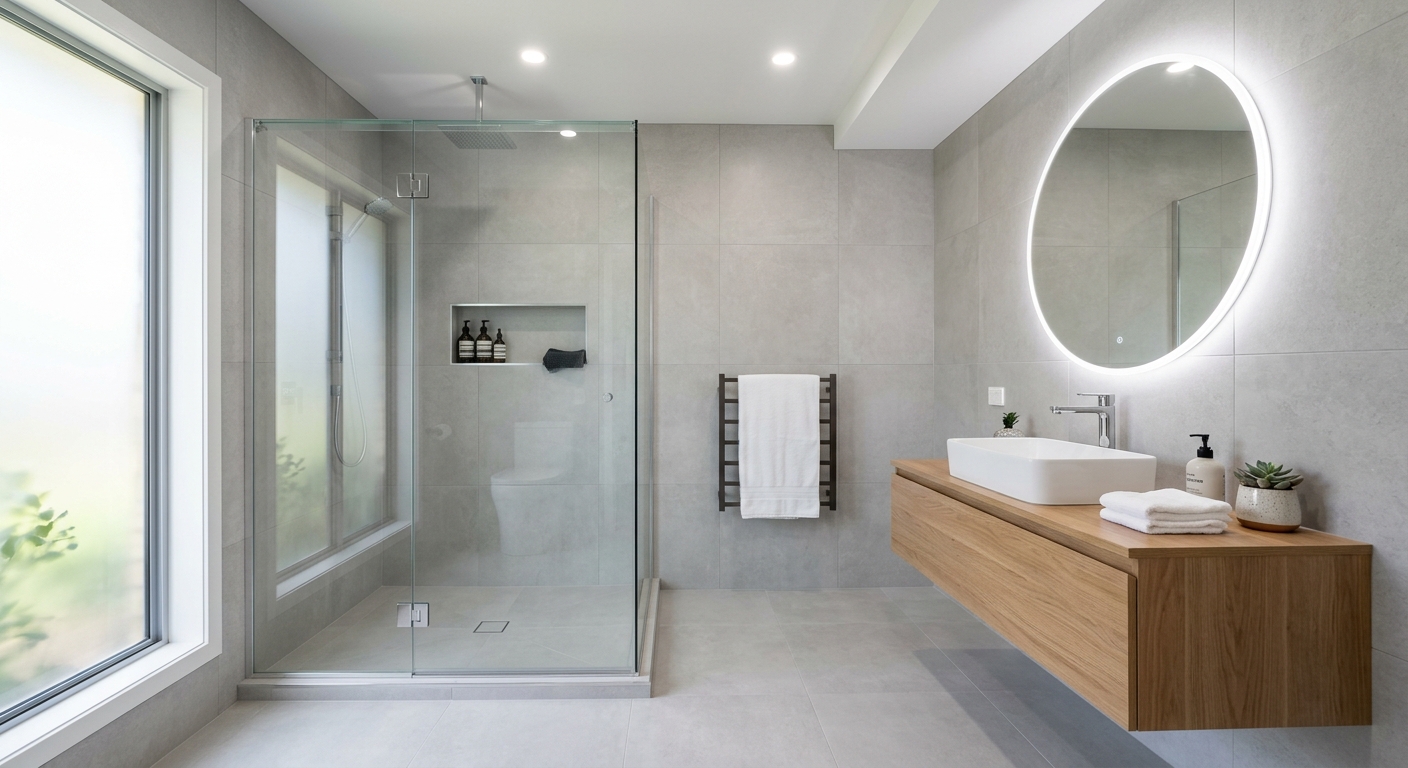
Bathroom renovation options and costs in Tweed
In Tweed, homeowners typically start by asking what their bathroom renovation “should” cost—then they discover the answer depends on how much you change behind the walls. With 61.2% of homes in the area built before 1981 (Statistics Canada, 2021 Census), many projects begin with dated layouts and older drain and supply arrangements that don’t always match modern waterproofing and ventilation requirements. In practice, even when you only plan cosmetic work, demolition can reveal uneven subfloors, tired mortar beds, or plumbing that needs remedial upgrades.
The Kingston–Pembroke market also shapes pricing because older housing stock drives discovery of hidden issues more than weather does. Tweed’s cold winters don’t automatically “raise” labour rates, but they do affect scheduling and drying times—especially for back-to-back tile, membrane, and grout steps. Labour demand can be tight during peak renovation months around Kingston and Belleville, so bathroom crews sometimes prioritize jobs with clear scope, stable material choices, and easy access. In Tweed, trade activity is especially common in long-established residential pockets along the downtown corridor and in older neighbourhoods near the Highway 37/127 approach roads, where many homes are similar in age and construction.
For planning, use these common scope bands as a baseline, then we’ll tighten the number once we know whether plumbing moves, electrical upgrades are needed, and how much waterproofing remediation is required. Compare options below to get a realistic range for your project.
| Renovation Scope |
What's Included |
Typical Duration |
Price Range |
| Cosmetic refresh (paint, fixtures, accessories only) |
Paint, tap/fixture swaps (no plumbing relocation), vanity refresh if existing plumbing fits, re-caulk, lighting accessory replacement, toilet/vent cover cleanup as applicable |
3–7 days |
$4,500 – $9,000 |
| Mid-range full renovation (new tile, vanity, tub/shower, electrical) |
Demolition, subfloor prep, waterproofing, wall and floor tile, vanity + sink, tub/shower or alcove conversion, fan upgrade, new GFCI outlet(s) as required, basic trim and sealing |
2–3 weeks |
$15,000 – $25,000 |
| High-end full renovation (custom tile, steam shower, heated floors) |
Higher-spec tile and layouts, membrane system with extended treatment, custom shower elements (bench/linear drain options), heated floor wiring and controls, upgraded exhaust/lighting plan, premium fixtures and finishes |
3–5 weeks |
$26,000 – $32,000 |
| Shower-only installation (convert tub to walk-in shower) |
Remove tub, rough-in adjustments if needed, shower pan and waterproofing, glass door/enclosure, new shower valve/trim, tile surround and niche(s) |
1–2 weeks |
$6,000 – $12,000 |
| Bathtub replacement or tub-liner install |
Tub swap or liner system, drain/valve tie-in, re-seal at walls, targeted tile/caulking repair, leak test and caulk finish |
4–8 days |
$1,200 – $6,000 |
| Tile-only installation (floor + surround, existing layout kept) |
Tile removal (where needed), floor leveling/prep, waterproofing where appropriate, floor and wall tile, grout sealing and finishing; existing vanity/fixtures remain unless otherwise agreed |
1–2 weeks |
$2,000 – $10,000 |
Prices are estimates only and vary by project scope, site access and material selection.
What affects the price of bathroom renovation in Tweed
In the Kingston–Pembroke region, quotes for the “same” bathroom renovation can swing by 30–50% because scope usually expands once the walls come open. That’s not exaggeration—it’s common in older homes where plumbing routes, venting paths, and subfloor conditions don’t match what a homeowner sees on day one. Even with the same end finishes, labour time changes when crews must troubleshoot cast-iron drain sections, upgrade supply lines, or rebuild waterproofing details correctly around valves and corners.
For Tweed, regional labour rates and the age of the housing stock drive costs more than climate. Many bathrooms are retrofit spaces in homes where layouts were planned around older fixture sizes and wall thicknesses, which affects rough-in access. Older homes in this area often hide cast-iron or copper drain stacks that need upgrading, galvanized supply lines that can restrict flow, and ventilation that’s underperforming—each item expands scope. It’s also where discovery risk matters: if asbestos-containing materials are found (for example in pre-1985 vinyl floor tile or certain joint compounds), abatement protocols add budget—commonly on the order of $1,500–$5,000+ depending on extent.
Two local examples: a “tile-only” job often rises from the $2,000–$10,000 band once floor prep and waterproofing corrections are included; and a shower conversion can move quickly upward within the $3,500–$12,000 shower-install range if drain height or valve positioning must change. Conversely, pricing can stay nearer the mid-range (for instance $15,000–$25,000) when the layout is left alone and electrical work is limited to straightforward exhaust fan and GFCI updates. Keep in mind that humidity in Ontario demands a correct waterproofing sequence—skipping steps to save labour usually costs more later.
| Price Factor |
Why It Matters |
Cost Impact |
| Layout change |
Moving drain or supply lines requires rough-in work, cutting joists/walls where feasible, and correct venting considerations |
Typically adds 10–25% to labour; can push full renovations toward the upper band |
| Tile selection |
Large-format porcelain needs more precise substrate prep; mosaic increases setting and grouting time |
Often shifts tile-only and full renovations by 10–30% depending on pattern complexity |
| Fixture tier |
Valve/trim sets, toilets, and vanities vary widely in installation complexity and component pricing |
Can add $800–$4,000+ within a full reno, depending on brand and rough-in compatibility |
| Subfloor condition |
Rot, failed underlayment, or unlevel concrete adds demo, rebuild framing/leveling, and additional prep |
Commonly adds $1,000–$5,000 when replacement/leveling is extensive |
| Electrical |
New GFCI receptacles, exhaust fan, lighting, and heated floors require safe circuit planning and code-compliant work |
Often adds $500–$3,000 depending on whether wiring paths are accessible |
| Waterproofing method |
Membrane type and coverage (curb, corners, transitions) affects long-term durability and mold risk |
Usually adds $400–$2,000+ versus minimal waterproofing, but reduces call-backs |
| Older-home surprises |
Asbestos in old finishes, cast-iron drains, or galvanized pipes can trigger remedial plumbing and/or abatement |
Can add $1,500–$10,000+ in worst cases; minor surprises may be contained within plumbing allowances |
| Bathroom size |
Square footage drives tile quantity, substrate work, waterproofing coverage, and labour hours |
Often changes costs by 10–20% between small and standard-size baths |
Permits & regulations in Ontario
In Ontario, cosmetic bathroom updates are usually straightforward from a permitting perspective: swapping fixtures, replacing a vanity, painting, and retiling with no changes to plumbing or structural elements typically do not require a permit. However, if you’re relocating plumbing—such as moving a toilet, changing the shower valve location, or relocating drain and supply lines—permits and inspections are commonly required because rough-in work must meet current standards. Similarly, adding or upgrading mechanical ventilation (for example installing a new exhaust fan) often requires electrical permitting and inspection when it involves new circuits, junctions, or significant wiring changes.
Electrical work must be done or signed off by a licensed electrician to comply with Ontario electrical code requirements. That’s especially relevant for bathrooms because you’ll typically want properly protected GFCI outlets and correct fan/heated-floor circuit installation. Any plumbing rough-in changes typically require a permit and inspection, even when the finished fixtures look “normal.”
For a homeowner in Tweed, the practical way to verify a contractor is: (1) check the Ontario trade licence (where applicable to their scope) using the appropriate online registry; (2) request a certificate of insurance showing general liability coverage that matches the job size; (3) confirm WSIB/WCB status—contractors should provide a clearance letter or proof of coverage depending on how they’re registered. Ask for these items before work begins, and ensure the insurance and coverage names match the legal entity on the quote.
Choosing tile, waterproofing and fixtures for your Tweed bathroom
In Tweed, your budget is largely controlled by three material decisions: tile choice, waterproofing method, and fixture tier. First, tile selection affects both the material price and the installation complexity. Ceramic tile is a solid entry option for floor and walls, but it typically offers less durability in wet areas than higher-grade porcelain and may be less forgiving if your subfloor is older and slightly uneven. Porcelain tile is often the mid-range sweet spot because it handles moisture and everyday cleaning well, and it’s available in many looks—from wood planks to stone patterns—while usually staying within the broader “tile” price band you’ll see in the $2,000–$10,000 range for tile-only work.
Second, waterproofing is where Ontario humidity meets long-term performance. A paint-on membrane can be economical, but it’s sensitive to prep and coverage details. A bonded sheet membrane (or a system approach using compatible primers, membranes, and sealing at transitions) generally improves reliability for wet-room conditions. In older homes, where corners and transitions can be imperfect, a proper membrane method helps prevent the chronic issues that lead to mould and grout breakdown.
Third, fixture tier impacts both upfront cost and resale. Builder-grade fixtures can keep a project closer to the mid-range (like $15,000–$25,000 for a full reno when plumbing layout stays similar), but designer brands often add cost through trim sets, shower valves, and finish options. For example, choosing a premium valve trim and glass enclosure might add $1,500–$3,500, but it’s justified when it improves the shower experience and aligns with a durable waterproofing system—rather than when the budget is cut by using mismatched components.
| Material / Option |
Pros |
Cons |
Price Range |
| Ceramic tile (floor + walls) |
Good entry-level look, generally easier on budget, widely available sizes and colours |
Less durable than porcelain for certain wet-area uses; may chip more if substrate is unstable |
$2,000 – $6,500 |
| Porcelain tile (floor + walls) |
Better moisture performance, strong durability, many modern styles (stone/wood looks) |
Can cost more per tile; large-format installs demand excellent substrate prep |
$4,000 – $10,000 |
| Natural stone (marble, travertine, slate) |
High-end appearance, unique character and finishes |
Requires more careful sealing and maintenance; costs rise with pattern layout and cutting |
$8,000 – $18,000 |
| Frameless glass shower enclosure |
Modern, bright look; easier visual clean-up; works well with tiled showers |
More expensive; installation must be square and plumb to avoid leaks/fit issues |
$3,000 – $7,500 |
| Prefab tub surround (acrylic) |
Fast installation, good water resistance when properly sealed, lower labour and fewer grout lines |
Fewer design options; can limit custom niches/bench styles |
$1,200 – $3,500 |
| Custom shower pan (tile or linear drain) |
Improved layout flexibility; linear drains can look clean and modern; better for barrier-free design |
More skilled labour; requires high-quality waterproofing and slope planning |
$4,500 – $12,000 |
How to choose a bathroom renovation contractor in Tweed
Choosing a contractor in Tweed is less about flashy ads and more about proof: licensing for their scope, liability insurance, and WSIB/WCB coverage. Start by requesting their certificate of insurance and confirming the coverage limits are appropriate for a bathroom project (especially where tile, demolition, and plumbing/electrical work intersect). For WSIB/WCB, ask for a clearance letter or proof of coverage—this is a key protection for you as the homeowner. If they can’t provide documents quickly and clearly, that’s usually your first warning.
Next, get 2–3 itemised written quotes. The best quotes break down labour and materials separately (demo, framing/subfloor prep, waterproofing, tile setting, electrical allowance, plumbing allowance, disposal). Avoid “lump sum” numbers that don’t explain what happens if you find subfloor rot, need additional waterproofing, or discover older plumbing conditions common in pre-1981 homes. Ask if permits are included, who pulls them, and whether disposal/dump fees are covered.
Warranty matters. Confirm workmanship warranty length and what it covers (often tile/waterproofing-related issues) versus manufacturer warranties on products (like valves, membrane, or glass). Clarify whether warranties are transferable if you sell the home. For payment, keep it tight: never pay more than 10–15% upfront, and use a holdback until the job is complete and cleaned. Lastly, request a start date and a completion estimate in writing, including inspection timing if permits are required.
- Provide Ontario licence details for their scope and confirm it matches the legal name on the quote.
- Show certificate of insurance (general liability) and confirm the project is covered.
- Provide WSIB/WCB clearance or proof of coverage before work begins.
- Use itemised quotes (labour vs materials) instead of one lump sum.
- State what demolition includes and whether dump fees/disposal are included.
- Clarify what waterproofing system is being used and the scope (corners, transitions, bench/curb).
- Confirm electrical scope: GFCI outlets, exhaust fan, heated floors—who supplies and who installs.
- Confirm plumbing scope: rough-in changes, valve compatibility, and leak-test procedures.
- Require a written timeline with key milestones (demo, waterproofing cure, tile set, trim, final caulk).
- Ask what happens if asbestos/as-needed abatement is discovered (process and cost handling).
- Check warranty terms in writing: workmanship vs manufacturer, duration, and exclusions.
- Use a payment schedule with limited upfront payment and a holdback until punch-list completion.
In Tweed, common red flags include: vague quotes that omit waterproofing details, contractors who won’t provide insurance/WSIB proof, “cash-only” payment pressure beyond a small deposit, no written start/completion timeline, and workmanship warranties that are either missing or don’t mention moisture/waterproofing coverage.
Frequently asked questions — bathroom renovation in Tweed
Can I live at home during a bathroom renovation in Tweed?
Often, yes—especially if you’re doing a shower-only or cosmetic refresh while keeping access to another bathroom. In Tweed and the Kingston–Pembroke region, full renovations can take 2–3 weeks in typical mid-range scenarios, so living arrangements usually depend on whether the toilet/shower is available during demo. If your project includes replacing a tub or converting to a walk-in shower, the rough-in and waterproofing steps can temporarily leave the space unusable, even if drywall and tile work is confined to one area. A good contractor will stage the work so you can use plumbing as soon as the rough-in is sealed and tested. If your home is the only bathroom, you may need a short alternative setup.
What's the best bathtub material for a Tweed home?
For most Tweed homeowners, the “best” bathtub material balances durability, comfort, and practicality. An acrylic tub replacement is usually the lowest-cost, often landing within the $1,200–$6,000 bathtub/fixture replacement band, and it’s relatively straightforward to install if access is good. Cast-iron tubs are very durable but can cost more and are heavier for delivery and removal—timing and subfloor structure matter in older homes. In pre-1981 properties (Statistics Canada, 2021 Census), assess whether the floor is stable enough before choosing a heavier system. If you’re trying to keep costs down without major demo, a tub-liner approach can work, but it depends on the condition of the existing tub surface and the quality of the seal.
Is it worth renovating a bathroom before selling in Tweed?
Typically, yes—if you focus on fixes that reduce buyer risk (waterproofing, ventilation, and dated finishes) rather than purely cosmetic changes. In a town where many homes are older (61.2% built before 1981), buyers often expect modern moisture protection, functional exhaust, and updated plumbing performance. A mid-range full renovation commonly falls around $15,000–$25,000 when layout changes are limited; that’s a reasonable “buyer-confidence” spend compared to high-end custom upgrades that may not fully recoup costs. If your bathroom has early signs of water damage, mouldy caulk, or poor fan performance, renovating before listing usually helps. However, if the reno requires significant plumbing relocation or hidden repairs, make sure you’re not over-improving beyond the neighbourhood’s typical price point.
How do I plan a bathroom renovation on a tight budget in Tweed?
Start with scope control. If you keep the plumbing layout the same, you can often stay closer to the mid-range bands, such as $15,000–$25,000 for a full renovation, or use smaller scopes like tile-only ($2,000–$10,000) or a bathtub/fixture replacement ($1,200–$6,000). Prioritize waterproofing quality first, because cutting corners there is the most expensive mistake later. Consider choosing porcelain tile in a simpler pattern instead of natural stone, and pick a builder- to mid-range vanity that fits your existing rough-in. Also, plan for ventilation: an upgraded exhaust fan and correct sealing are often better value than upgrading every visible surface. Get itemised quotes and include a contingency for older-home surprises (subfloor prep, valve compatibility, or potential abatement if older materials are found).
What's the difference between a cosmetic and a full bathroom renovation?
A cosmetic renovation is surface-focused: paint, fixture accessories, replacing a vanity if plumbing still fits, and updating lighting and caulking without moving plumbing or changing the core waterproofing system. These are often faster—commonly within a week for smaller refreshes—and usually cost less than full renovations. A full renovation goes beyond finishes: it typically includes demolition, subfloor prep, a waterproofing system, new tile or a new shower/tub build, and often electrical updates like GFCI outlets and an exhaust fan. In the Kingston–Pembroke market, a mid-range full bathroom renovation commonly lands around $15,000–$25,000 depending on scope. If you’re converting a tub to a walk-in shower, that’s usually priced as a shower installation scope, with ranges often starting in the $3,500–$12,000 band.
How do I choose the right contractor for my bathroom in Tweed?
In Tweed, choose a contractor who can prove they’re set up to do the work safely and correctly: confirm Ontario licensing for their scope, request a certificate of insurance, and verify WSIB/WCB coverage (ask for a clearance letter or proof). Then insist on itemised quotes, not a single number—make sure waterproofing, disposal/dump fees, and permit responsibility (if required) are spelled out. Read the scope carefully: what’s included in demolition and what repairs are covered if rot is found? Ask about the workmanship warranty and whether it covers waterproofing-related issues. Finally, align your timeline: get a start date and a realistic finish estimate in writing, and confirm material lead times. If they can’t answer these clearly, keep looking.