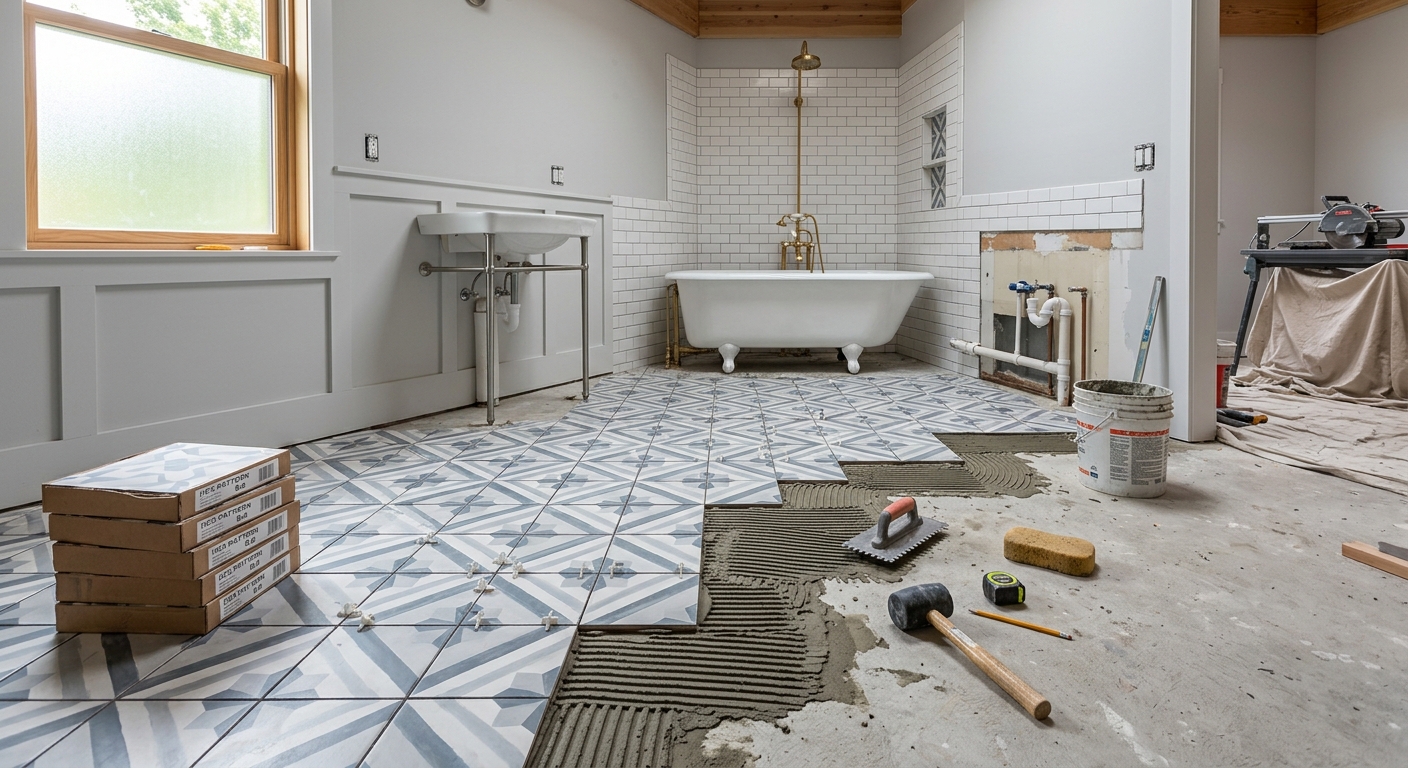
Bathroom renovation options and costs in Norfolk County
Norfolk County homeowners typically renovate bathrooms for comfort, resale appeal, and to solve older-home plumbing or ventilation issues—especially in a region where 62.0% of dwellings were built before 1981 (Statistics Canada, 2021 Census). With 82.7% of homes being single-detached, it’s common to find basements, shared stacks, and service runs that are straightforward to access—yet dated drain layouts can still expand scope once walls come down. That matters in Norfolk County because the Hamilton–Niagara Peninsula market often uncovers hidden problems behind finishes, such as cast-iron drains, galvanized supply lines, and occasional asbestos in older floor tile or drywall compounds (abatement can be required). While Ontario’s winters don’t “wreck” bathrooms, freeze-thaw and indoor humidity swing with the seasons can stress poorly detailed waterproofing and ventilation. On top of that, pricing is driven more by the age of local housing stock and labour availability than by weather alone. Trades demand is especially strong around the county’s busier service corridors, including the Simcoe–Port Dover area, where multiple renovations often overlap with contractor scheduling.
Because of these realities, the same bathroom size can fall anywhere from a cosmetic refresh to a full plumbing-and-waterproofing replacement. Use the cost ranges below as a starting point before you collect itemised quotes.
| Renovation Scope |
What's Included |
Typical Duration |
Price Range |
| Cosmetic refresh (paint, fixtures, accessories only) |
Paint, replace vanity/faucet (no plumbing relocation), toilet swap, new mirror/light if existing wiring allows, hardware/accessories, caulking/spot trim |
2–4 days |
$2,500–$6,000 |
| Mid-range full renovation (new tile, vanity, tub/shower, electrical) |
Demo and disposal, subfloor spot repairs, waterproofing and new tile (typical layout), vanity, tub/shower or surround, new exhaust fan/lighting (as required), basic rough-in verification |
7–14 days |
$12,000–$25,000 |
| High-end full renovation (custom tile, steam shower, heated floors) |
Full demo, premium waterproofing system, designer tile layout, heated floor prep and controls, custom shower assembly (or steam), upgraded electrical/venting, upgraded fixtures |
2–4 weeks |
$25,000–$45,000 |
| Shower-only installation (convert tub to walk-in shower) |
Convert plumbing to a shower configuration (drain location verification), waterproofing and tile, new walk-in shower door or glass, exhaust/lighting checks |
7–12 days |
$8,000–$18,000 |
| Bathtub replacement or tub-liner install |
Remove old tub (or fit liner), re-caulk/grade adjustments, new surround finishing, plumbing connection checks, leak testing |
3–7 days |
$1,500–$6,000 |
| Tile-only installation (floor + surround, existing layout kept) |
Tile demo only as needed, membrane prep, new floor and wall tile, grout/seal, reinstallation of fixtures where possible without moving plumbing |
5–10 days |
$3,000–$10,000 |
Prices are estimates only and vary by project scope, site access and material selection.
What affects the price of bathroom renovation in Norfolk County
In the Hamilton–Niagara Peninsula region, the same bathroom renovation can price out 30–50% differently across bids—sometimes even with identical “fixtures”—because contractors price for what they expect to find once walls are opened. Ontario labour rates, scheduling demand, and how trades coordinate plumbing/electrical/tile all influence costs, but the big driver here is the age of the housing stock. In Norfolk County, with 62.0% of homes built before 1981 (Statistics Canada, 2021 Census), hidden systems are frequently dated: cast-iron or older drain assemblies, galvanized supply lines, and ventilation that doesn’t meet modern performance expectations. Those discoveries push projects from a mid-range full renovation (often around $12,000–$25,000) toward higher plumbing-and-finishing scope, including upgrades that may add $2,000–$8,000 to the budget.
Asbestos-related scope is another reason bids diverge. If asbestos is found in older vinyl floor tile or suspect drywall compounds, abatement protocols can be required; that typically adds about $1,500–$5,000+ in cost depending on extent and removal method. Local conditions also affect cost in practical ways: for example, a home with easy access to shutoffs and joists can reduce rough-in labour time, while an older bathroom under a finished floor can require more demolition to correct slopes. Similarly, if you keep the existing layout and avoid moving drains, costs tend to stay closer to tile-only installation budgets (often $3,000–$10,000), but layout changes quickly expand rough-in work.
| Price Factor |
Why It Matters |
Cost Impact |
| Layout change — moving drain or supply lines requires rough-in work |
New drain lines, trap/vent details, and supply routing increase demolition and coordination |
Typically adds $2,000–$8,000+ |
| Tile selection — large-format porcelain vs. mosaic vs. ceramic |
Harder materials need better substrate prep and specialized cutting; mosaic increases labour time |
Usually adds $500–$3,500 |
| Fixture tier — builder-grade vs. mid-range vs. designer brands |
Higher tiers can require upgraded plumbing components and more install time (alignment/finishing) |
Varies by $1,000–$6,000+ |
| Subfloor condition — rot or unlevel concrete adds scope |
Water damage may require joist repair, new backer systems, or leveling before tile |
Commonly adds $800–$4,000+ |
| Electrical — adding GFCI outlets, exhaust fan, heated floor circuit |
Code requirements and wiring/box changes can add labour and electrician time |
Typically adds $500–$3,500 |
| Waterproofing method — membrane type and extent |
Quality membranes reduce callbacks; full coverage (curbs/wet areas) costs more than paint-on alone |
Usually adds $400–$2,500 |
| Older-home surprises — asbestos tile, cast-iron drains, galvanized pipes |
Unexpected remediation and replacements increase demo and disposal, and may affect plumbing rough-in |
Often adds $1,500–$8,000+ |
| Bathroom size — sq ft drives tile and labour time directly |
More area means more substrate work, thinset/grout, and longer installation cycles |
Typically shifts total by 10%–40% |
Permits & regulations in Ontario
In Ontario, not every bathroom update needs a permit, but the line is usually about whether you’re moving plumbing, changing electrical scope, or altering structural elements. Cosmetic updates—like swapping a vanity top, replacing a toilet, re-caulking fixtures, or retiling using the existing layout—typically do not require a permit. What does require a permit commonly includes relocating plumbing (moving a drain or supply line), adding or changing an exhaust fan where new wiring/circuit work is required, and any structural changes that affect load-bearing walls or framing. Electrical work must meet Ontario electrical safety requirements and be performed by (or signed off by) a licensed electrician.
A practical way for a Norfolk County homeowner to verify compliance is to follow a simple sequence before signing: (1) ask for the contractor’s Ontario trade licence details and confirm they match the scope; (2) request a certificate of insurance and verify it includes liability coverage appropriate for renovation work; (3) confirm WSIB/WCB coverage for workers (or equivalent clearances where applicable); and (4) when permits are needed, ask whether the contractor will pull the permit and include inspections as part of the quote.
Step-by-step verification is straightforward: check the contractor licence through the appropriate online registry, review the insurance certificate for policy dates and coverage limits, and look for proof of WSIB/WCB clearance. Then compare that paperwork against what’s listed in your contract (permit responsibilities, exclusions, and inspection handling).
Choosing tile, waterproofing and fixtures for your Norfolk County bathroom
To control your bathroom renovation budget in Norfolk County, focus on three material decisions that move both cost and long-term performance: tile choice, waterproofing method, and fixture tier. First, tile selection: entry-level ceramic can be budget-friendly, but it may be less forgiving in high-splash areas and can require extra attention to substrate flatness. Porcelain is a common mid-range sweet spot for floors and shower walls because it’s denser and typically handles wear better. Natural stone (marble, travertine, slate) looks premium, but installation complexity and finishing/sealing requirements can push labour and material costs higher.
Second, waterproofing method: paint-on membranes are usually the fastest, but a full bonded sheet membrane or a modern system (often including a prefabricated drain and system-compatible detailing at corners/curbs) can better protect against Ontario’s indoor humidity and seasonal temperature swings. In practice, a well-detailed waterproofing layer can be the difference between a bathroom that stays quiet for years and one that shows mould or grout failures.
Third, fixture tier: builder-grade fixtures can keep you near the lower end of the mid-range band, while mid-range or designer brands can add significant cost—but they can also improve consistency of performance (valve quality, shower head flow, and finish durability), which supports resale.
A useful example: upgrading from a standard ceramic shower surround to porcelain and adding a more robust waterproofing system might add a few thousand dollars, yet it’s often justified when your home is older and wall surfaces may not be perfectly flat—so the extra investment reduces the risk of callbacks.
| Material / Option |
Pros |
Cons |
Price Range |
| Ceramic tile (floor + walls) |
Lower material cost, wide style selection, good for keeping budgets predictable when layout is simple |
Can be more porous; requires good grout detailing; less wear-resistant than porcelain |
$3,000–$7,000 |
| Porcelain tile (floor + walls) |
Durable for floors, often better suited for wet areas, cleaner look with modern large formats |
Heavier tile can increase installation effort; premium styles cost more |
$5,000–$10,000 |
| Natural stone (marble, travertine, slate) |
High-end appearance, distinctive character, great for feature walls or luxury looks |
More expensive materials, requires sealing/maintenance, substrate prep is critical |
$8,000–$18,000 |
| Frameless glass shower enclosure |
Premium visual upgrade, easy to clean, supports modern shower lines |
Higher hardware cost; accurate installation needed to avoid leaks and alignment issues |
$2,000–$6,000 |
| Prefab tub surround (acrylic) |
Fast installation, fewer tile labour days, good value when you want to keep plumbing changes minimal |
Less custom than tile; seams and edges may be less “luxury” than full tile |
$1,000–$3,000 |
| Custom shower pan (tile or linear drain) |
Better slope control, clean modern look with linear drain option, improves water management |
More detail work; requires precise waterproofing and drain installation |
$2,500–$8,500 |
How to choose a bathroom renovation contractor in Norfolk County
Choosing the right contractor in Norfolk County starts with proof, not promises. Verify Ontario licensing relevant to the work scope, request liability insurance (confirm the certificate is current and lists the correct insured parties), and confirm WSIB/WCB coverage for their workers. If a contractor can’t provide clear documentation, treat that as a serious planning risk—especially in older homes where hidden plumbing or waterproofing issues can create change orders.
Next, get 2–3 itemised written quotes. You want a breakdown that shows labour and materials separately (tile labour, waterproofing system, plumbing rough-in allowance, electrical allowance, disposal), plus what’s included/excluded. A lump-sum quote with vague language can hide costs that usually become unavoidable on older bathrooms—like drain upgrades, subfloor corrections, or permit handling.
Read warranty terms carefully: confirm the workmanship warranty length (how long they stand behind installation), the product/manufacturer warranty for fixtures and waterproofing materials, and whether those warranties are transferable to you. For payment scheduling, avoid large deposits—never pay more than 10–15% upfront—and use a holdback until key items are complete and inspected. Finally, insist on a start date and a completion estimate in writing, with how schedule delays will be communicated.
- Ask for licence and proof of liability insurance before the quote is finalized.
- Request WSIB/WCB clearance documentation (or equivalent proof of coverage).
- Get 2–3 quotes with itemised labour/materials, not a single total.
- Confirm whether permits (if needed) are included or added separately.
- Verify disposal/rubbish removal is included.
- Ask what waterproofing system is proposed (and where it’s applied).
- Confirm if the subfloor will be assessed and corrected before tile.
- Require a written scope for plumbing: will they pressure-test and leak-test?
- Check that electrical scope includes required GFCI/exhaust fan upgrades when necessary.
- Ask about grout/caulking details at changes of plane and corners.
- Review warranty coverage in writing (workmanship vs. manufacturer warranty).
- Use a payment schedule with a holdback until final walkthrough and punch-list completion.
In Norfolk County, common red flags include: quotes that don’t list waterproofing or electrical scope clearly, contractors who won’t provide proof of insurance/coverage, vague “allowances” that inflate after demolition, no stated timeline or change-order process, and payment requests that exceed 10–15% upfront. If you see those patterns, keep looking.
Frequently asked questions — bathroom renovation in Norfolk County
How much does a walk-in shower cost in Norfolk County?
A walk-in shower cost in Norfolk County typically depends on whether you’re converting from a tub, how much tile you want, and if plumbing lines need moving. In this Hamilton–Niagara Peninsula market, a shower-only installation (e.g., converting tub to walk-in) commonly lands around $8,000–$18,000, because contractors often must verify drains, trap/vent details, and waterproofing transitions once the wall is opened. If you keep the same plumbing layout and choose a simpler tile approach, you may stay nearer the lower end, while linear drains, frameless glass, and premium waterproofing usually push the total higher. Homes built before 1981 can add cost if drain upgrades or ventilation corrections become necessary. (Statistics Canada, 2021 Census)
What's the ROI on a bathroom renovation?
Bathroom renovations usually improve day-to-day comfort and can support resale value, but ROI varies based on the quality of waterproofing, fixture durability, and whether the renovation “solves” functional issues. In Norfolk County’s older housing stock—where 62.0% of homes were built before 1981—buyers often pay attention to signs of moisture control, properly detailed shower waterproofing, and modern ventilation. (Statistics Canada, 2021 Census) A mid-range full renovation often sits around $12,000–$25,000, and projects that correct plumbing/ventilation and use reliable waterproofing tend to reduce buyer hesitation. Over-customizing without practical upgrades (like heated floors) can limit ROI, especially if it drives the budget into the high-end band (up to $25,000–$45,000) without addressing functional deficiencies.
Do I need waterproofing behind the tile?
Yes—waterproofing behind shower and wet-area tile is a core requirement, not an optional extra. In Ontario bathrooms, humidity and seasonal temperature changes make bathrooms unforgiving if moisture can migrate behind tile. A reputable contractor should use a system-appropriate waterproofing approach (for example, a bonded sheet membrane or a validated membrane system) with proper detailing at corners, niches, curb/wet edges, and around drains and plumbing penetrations. “Right behind the tile” doesn’t mean the same method in every situation, but the concept is the same: prevent water from reaching the wall structure and subfloor. In older Norfolk County homes, hidden water damage can already exist behind finishes, so the waterproofing choice also depends on whether substrates need repair or leveling before tile goes in.
How do I compare bathroom renovation quotes?
Compare quotes by scope and line items, not just the final total. For Norfolk County projects, look for clarity on: demolition and disposal, waterproofing method, tile coverage and layout assumptions, fixture list, whether electrical work includes exhaust fan/GFCI updates, and how plumbing is addressed if drains or shutoffs are outdated. Quotes often vary by 30–50% when one contractor has already allowed for older-home surprises (like potential drain upgrades or asbestos-related scope) and another has not. Also check whether the quote includes permits/inspections, patching/repair allowances, and testing like pressure tests or leak tests. A mid-range full renovation is often around $12,000–$25,000, so if one bid is much lower but skips waterproofing details, it’s a warning sign.
Can I live at home during a bathroom renovation in Norfolk County?
Often, yes—many Norfolk County homeowners can remain in the home, especially if they’re renovating a single bathroom and the main plumbing route still allows basic use elsewhere. That said, timelines and dust control matter. During active demo and tile/waterproofing work, expect disruption, increased moisture/drying time, and limited access to the shower area. Most contractors plan around critical phases like waterproofing cures and grout/caulk set times, and they’ll protect other finishes to manage dust. If the project includes major plumbing relocation, electrical upgrades, or a complete bathroom shutdown, it may be harder to live normally—especially in households where only one bathroom exists. When you request your start/completion schedule in writing, ask whether they can sequence the work to keep a toilet available and minimize downtime.
What's the best bathtub material for a Norfolk County home?
The “best” bathtub material depends on your tolerance for weight, installation method, and desired finish. Common options include acrylic tubs, which are lighter and often simpler to install, and refinishing/tub-liner approaches for cost control—especially when you want to avoid major plumbing disruption. For a bathtub replacement or tub-liner install, budgeting typically falls around $1,500–$6,000. In older Norfolk County homes (many built before 1981), choosing a lighter tub can reduce subfloor stress and simplify replacement if the surrounding structure is fragile. However, the real performance differentiator is not just material—it’s correct leveling, proper caulking and sealing at the tub flange, and ensuring the plumbing connections and venting are up to date. A thorough leak test after install is critical.