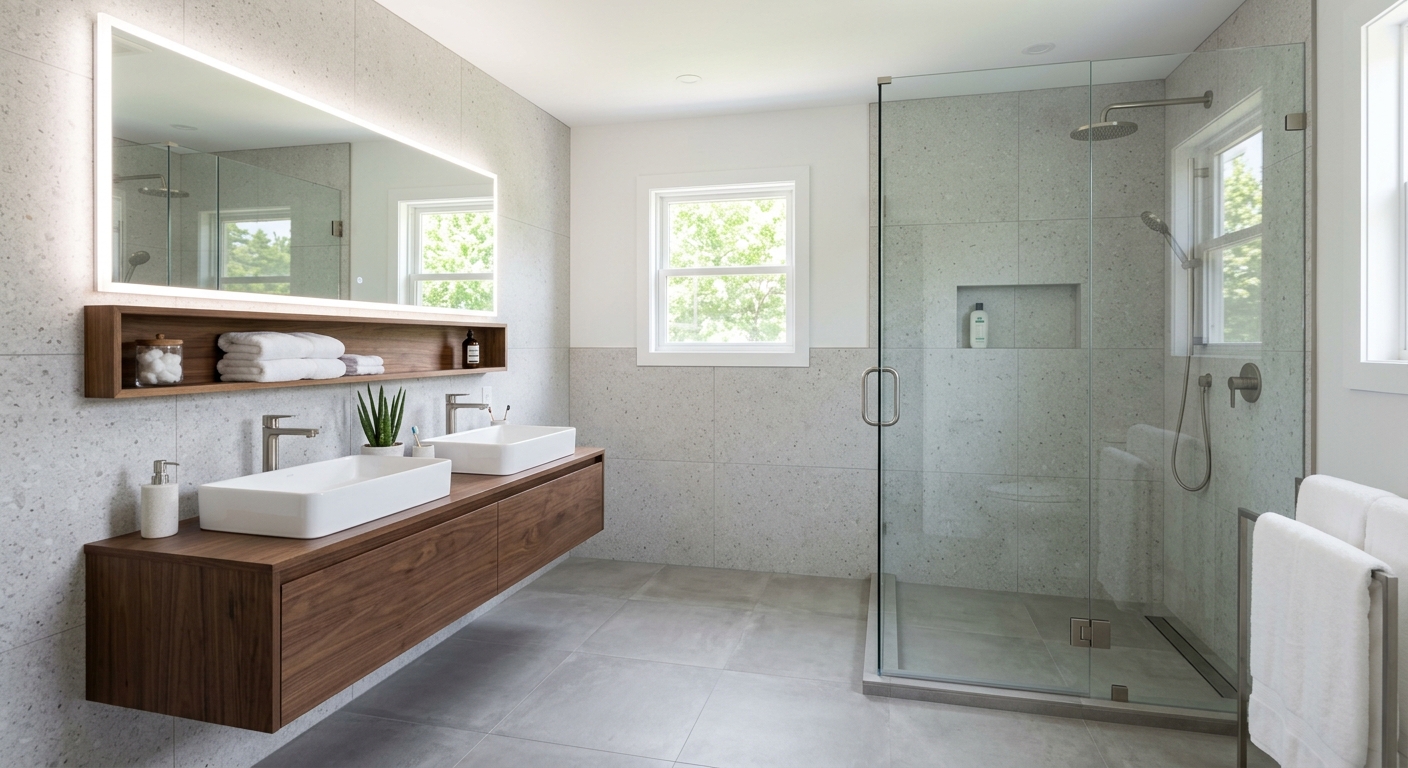
Bathroom renovation options and costs in North Vancouver
In North Vancouver, bathroom renovation costs tend to move the fastest once crews start opening walls and floors, because the city’s older housing mix means there’s often something to uncover behind finished surfaces. With 44.0% of homes built before 1981 (Statistics Canada, 2021 Census), many projects begin with what looks like a straightforward refresh but quickly encounter aged plumbing layouts, dated venting, and in some cases materials that require extra care. On top of that, the Lower Mainland–Southwest market has some of the highest labour rates in the province—so even a “small” bathroom can become expensive once multiple trades are scheduled (plumbing, electrical, tiling, waterproofing).
Weather plays a role, but it’s usually the market and labour supply that drive the budget more than North Vancouver’s coastal conditions. Steam and moisture still demand high-quality waterproofing and properly ducted exhaust, yet the bigger cost surprises come from contractor availability and the need to bring systems up to current British Columbia expectations when walls are opened. In neighbourhoods like Lynn Valley—where detached homes are common and renovation demand stays strong—tilers and licensed trades can be booked further out, which can affect scheduling and final pricing.
Below are realistic options homeowners commonly compare in North Vancouver, from cosmetic updates to full conversions, so you can benchmark quotes before you choose a scope.
| Renovation Scope |
What's Included |
Typical Duration |
Price Range |
| Cosmetic refresh (paint, fixtures, accessories only) |
Paint, vanity or faucet swap, toilet/lighting replacement (no rough-in changes), caulking, accessories |
2–5 days |
$3,000–$8,000 |
| Mid-range full renovation (new tile, vanity, tub/shower, electrical) |
Demo, subfloor checks, tile floor + surround, vanity, tub/shower or alcove unit, exhaust fan upgrade, electrical updates for GFCI and lighting, basic waterproofing |
2–4 weeks |
$18,000–$35,000 |
| High-end full renovation (custom tile, steam shower, heated floors) |
Custom tile layout, premium waterproofing system, heated floor circuit, steam shower or premium shower components, upgraded ventilation, designer finishes |
4–7 weeks |
$35,000–$45,000 |
| Shower-only installation (convert tub to walk-in shower) |
Demo tub, build shower pan, waterproofing, glass door, new valve trim, new tile work, exhaust fan review/upgrade |
2–3.5 weeks |
$18,000–$30,000 |
| Bathtub replacement or tub-liner install |
Replace tub and faucet trim (or liner), re-seal surround, localized tile touch-ups, plumbing reconnect, basic waterproofing at seams |
1–2.5 weeks |
$1,500–$6,000 |
| Tile-only installation (floor + surround, existing layout kept) |
Tile floor and wall surround, surface prep, waterproofing/membrane where required, grout/seal, reinstallation of fixtures (no major plumbing moves) |
1.5–3 weeks |
$2,000–$8,000 |
Prices are estimates only and vary by project scope, site access and material selection.
What affects the price of bathroom renovation in North Vancouver
If you’re comparing quotes for the same bathroom in North Vancouver, it’s common to see 30–50% differences even when the “visible” scope sounds similar. In the Lower Mainland–Southwest region, labour rates and the age of local housing stock are the main drivers—more than climate alone. North Vancouver has a large share of older homes (44.0% built before 1981, Statistics Canada, 2021 Census), and that’s where hidden costs stack up: cast-iron or older drain components, dated copper supply lines, inadequate venting, and sometimes questionable electrical pathways around wet areas. Once walls are opened, many bathrooms require plumbing and venting upgrades to make everything functional and compliant.
Asbestos is a common concern in pre-1985 renovations. Discovery of asbestos-containing materials in vinyl floor tile, drywall compound, or insulation triggers abatement protocols, which can add roughly $1,500–$5,000+ to the budget depending on what’s found and how much must be remediated. That’s one reason a project that starts as “tile and a vanity” can quickly align with a mid-range full renovation budget such as $18,000–$35,000.
Two concrete North Vancouver examples that swing price are: (1) upgrading an undersized exhaust fan duct path when the bathroom venting doesn’t reach an appropriate termination—this often forces additional carpentry and electrical; and (2) correcting an out-of-level subfloor before setting large-format tile, which can mean extra prep and time. On the other side, if your plumbing rough-in is already in good shape and you keep the layout, tile-only scopes like $2,000–$8,000 stay more predictable.
| Price Factor |
Why It Matters |
Cost Impact |
| Layout change — moving drain or supply lines requires rough-in work |
New drain routes and valve locations add demolition, framing, and plumbing labour |
Often +$3,000–$10,000 depending on distance and access |
| Tile selection — large-format porcelain vs. mosaic vs. ceramic |
Harder tile needs better prep, more cutting, and higher skilled labour time |
Often +$1,500–$6,000 |
| Fixture tier — builder-grade vs. mid-range vs. designer brands |
Valves, shower systems, and vanities vary widely in hardware cost and install complexity |
Often +$800–$7,000 |
| Subfloor condition — rot or unlevel concrete adds scope |
Water damage repair and prep work can expand the build-up layers |
Often +$1,000–$5,000 |
| Electrical — adding GFCI outlets, exhaust fan, heated floor circuit |
Licensed electrical work plus required code changes and new circuit routing |
Often +$800–$4,000 |
| Waterproofing method — membrane type and extent |
Quality membranes and correct detailing reduce future leaks and callbacks |
Often +$700–$3,000 |
| Older-home surprises — asbestos tile, cast-iron drains, galvanized pipes |
Remediation and replacement require additional trades and controlled work areas |
Often +$1,500–$12,000+ |
| Bathroom size — sq ft drives tile and labour time directly |
More surface area means more tile, grout, waterproofing, and longer installation time |
Often +$2,000–$12,000 |
Permits & regulations in British Columbia
In British Columbia, the key is whether your changes stay “cosmetic” or start modifying plumbing, electrical, ventilation, or structure. Cosmetic updates—like swapping a vanity, replacing a faucet, changing lighting fixtures, re-caulking, repainting, or retiling without moving plumbing—typically do not require a permit in most common homeowner renovations. However, permits are typically required when you relocate plumbing (moving a drain or supply line), add or replace a bathroom exhaust fan where new wiring or ducting is involved, or make structural wall changes that affect framing or load paths.
Electrical work must meet provincial code and should be done or signed off by a licensed electrician. Likewise, plumbing rough-in changes usually require a permit and inspection before the walls are closed. If you’re doing a tub-to-shower conversion and the valve location changes, treat it as rough-in plumbing work. When in doubt, ask the contractor what permits they will pull and schedule inspections for—then confirm the plan in writing before demolition starts.
To verify a contractor in North Vancouver: (1) request their certificate of insurance (liability) and confirm the policy is active; (2) ask for their relevant British Columbia trade licence details; and (3) confirm workers’ coverage—commonly via WCB/WSIB clearance documentation for the company and its subcontractors—before work begins. If they can’t provide certificates on request, that’s a red flag and a good reason to pause.
Choosing tile, waterproofing and fixtures for your North Vancouver bathroom
In North Vancouver, the fastest way to control your bathroom renovation budget is to make smart material decisions early—because tile, waterproofing, and fixtures directly determine labour complexity and long-term performance in a humid coastal environment. First, tile choice: ceramic is usually the entry point for floor and wall tile, but porcelain is often the better mid-range value because it’s denser, more consistent, and holds up well in wet zones. Natural stone (marble, travertine, slate) can look exceptional, but it brings higher material costs and more detailed installation and sealing considerations.
Second, waterproofing method: paint-on membranes can work in limited applications, while bonded sheet membranes (or modern systems that include compatible boards/membranes and correct seam treatment) generally provide more robust protection when done correctly. In British Columbia, bathrooms are moisture-prone—so the “right” waterproofing is the system your installer can execute properly, with correct overlaps, corner detailing, and drain treatment. Cutting corners on membrane type, thickness, or cure times is what leads to future mould and grout failure.
Third, fixture tier: builder-grade fixtures save money up front, mid-range offers better finishes and smoother valves, and designer brands often justify their cost with higher-quality components and better longevity. For example, choosing a mid-range porcelain tile and a dependable waterproofing system may cost a bit more than ceramic, but it can avoid expensive rework if you find movement or leaks later. A premium switch to heated floors is also easier to justify in a full renovation scope (often $18,000–$35,000) than in a cosmetic refresh, because wiring and substrate prep have to be planned during the build.
| Material / Option |
Pros |
Cons |
Price Range |
| Ceramic tile (floor + walls) |
Lower material cost, wide style selection, generally straightforward for installers |
Can be less durable in high-splash zones; may be more prone to chips if heavy impacts |
$2,000–$5,500 |
| Porcelain tile (floor + walls) |
Durable, water resistant, consistent sizing for cleaner layouts |
Can cost more per sq ft and may require higher-end thinset and careful prep |
$3,500–$8,000 |
| Natural stone (marble, travertine, slate) |
Luxury look, unique veining, strong curb appeal |
Higher material and sealing/maintenance needs; heavier and slower to install |
$6,000–$12,000+ |
| Frameless glass shower enclosure |
Modern appearance, visual lightness, easier cleaning than heavy frames |
Higher cost; requires accurate framing and door hardware alignment |
$2,500–$7,500 |
| Prefab tub surround (acrylic) |
Fast install, less tile labour, good for budget-friendly upgrades |
Design options can be limited; edges still require good sealing |
$1,500–$4,000 |
| Custom shower pan (tile or linear drain) |
Modern, sleek drainage, integrates with tile finish for a premium look |
More labour and detailing; must be perfectly waterproofed around the drain |
$6,000–$16,000+ |
How to choose a bathroom renovation contractor in North Vancouver
Choosing the right contractor in North Vancouver comes down to proof—licensing, insurance, and the quality of how they document scope. Start by verifying British Columbia trade licensing for the trades involved (plumbing and electrical in particular) and request evidence of liability insurance. Also confirm workers’ compensation coverage (WCB/WSIB) by asking for a clearance letter or equivalent documentation before work starts; it should cover the company and, where applicable, subcontractors.
Then, get 2–3 itemised written quotes rather than one “lump sum.” You want labour and materials broken out, including who supplies tile, membrane, thinset, backer board, shower hardware, exhaust fan, and what fixtures are included. Read exclusions line-by-line: Are permits included? Is disposal and dump fees included? Who handles unexpected subfloor damage once tile is removed? In North Vancouver’s older homes (many built before 1981, Statistics Canada, 2021 Census), these questions matter because hidden plumbing or subfloor conditions commonly expand scope.
For warranty, ask for two answers: the workmanship warranty length and what’s covered (leaks, grout failure, waterproofing defects), plus the manufacturer product warranty and whether it’s transferable to you. For payment, keep it controlled—never more than about 10–15% upfront; use progress payments and hold back until completion and walkthrough. Finally, insist on a signed schedule with a start date and estimated completion time.
- Ask for proof of BC trade licensing for the relevant trades (plumbing/electrical).
- Request liability insurance certificate before signing anything.
- Confirm workers’ compensation coverage (WCB/WSIB clearance documentation).
- Get 2–3 itemised quotes (labour vs materials) with clear model numbers.
- Confirm what is included in demolition and disposal/dump fees.
- Ask who pulls permits and whether inspections are scheduled.
- Check that waterproofing method and membrane brand/system are listed.
- Confirm the exhaust fan plan (ducting, ventilation path, and fan model).
- Request how subfloor issues will be assessed and priced if discovered.
- Review the warranty terms in writing for workmanship and products.
- Set a payment schedule with a defined holdback until punch list completion.
- Get a written timeline with milestones (rough-in, waterproofing, tile, install).
Concrete red flags to watch for in North Vancouver: (1) they won’t provide licence/insurance or try to “handle it later”; (2) quotes that don’t list brands/models for tile, membrane, fan, or shower hardware; (3) no stated waterproofing system details; (4) vague timelines like “a few weeks” with no start/completion dates; and (5) asking for a large deposit (well beyond 10–15%) before any work begins.
Frequently asked questions — bathroom renovation in North Vancouver
How long does a bathroom renovation take in North Vancouver?
Most North Vancouver bathroom renovations run about 2–4 weeks for a mid-range full renovation, especially when your scope includes new tile, a vanity, and updated electrical for lighting and GFCI protection. A shower-only conversion (commonly converting a tub to a walk-in) is often similar in timing—around 2–3.5 weeks—because plumbing rough-in and detailed waterproofing still take time. High-end upgrades with steam showers or heated floors can extend to 4–7 weeks, mainly due to product lead times and additional install steps. In older homes—many built before 1981—hidden issues (subfloor unevenness, older drains, or outdated venting) can add time, so it’s smart to plan contingency and ask how your contractor handles surprises. (Statistics Canada, 2021 Census)
Do I need a permit for a bathroom renovation in British Columbia?
In British Columbia, cosmetic work typically does not require a permit, such as replacing a vanity, swapping fixtures, repainting, or retiling when you don’t move plumbing. However, if your renovation involves relocating plumbing (moving drains or supply lines), changing ventilation by adding/replacing an exhaust fan circuit, or making structural or wall changes, you should expect permits and inspections. Electrical must be done or signed off by a licensed electrician, and plumbing rough-in changes generally require a permit before walls are closed. For homeowners in North Vancouver, the practical step is to ask your contractor: “What permits will you pull, and what inspections do you schedule?” Make sure permits are included in the written scope. If a contractor can’t clearly answer that, your timeline and cost can swing quickly.
What's the best tile for a bathroom in North Vancouver?
“Best” usually means the safest match for wet zones plus durability under local conditions. In North Vancouver’s humid, moisture-heavy bathroom environments, porcelain tile is often a strong choice: it’s dense, water-resistant, and typically holds up better than basic ceramic for floors and shower surrounds. If you want a budget option, ceramic can work well for floors and walls when installed with proper prep and grout selection, but porcelain is often more forgiving long-term. Natural stone looks premium, but it requires careful sealing and maintenance. A realistic cost approach is to plan for tile-only installations that land around $2,000–$8,000 when the layout stays put—then upgrade to porcelain or premium formats if you can justify the install complexity. The real win is waterproofing and correct detailing, not just the tile name.
Should I do a tub-to-shower conversion?
A tub-to-shower conversion is commonly worthwhile in North Vancouver if you want easier daily use, lower maintenance, and better accessibility over time. It’s also a practical choice when your tub is aging, or the plumbing fixtures are due for refresh. That said, it usually isn’t the cheapest bathroom change because it involves demo, shower pan construction, waterproofing, and often valve and drain refinishing. In Lower Mainland–Southwest pricing, many shower conversions land in the $8,000–$25,000 band depending on glass, tile complexity, and whether plumbing must be reworked. If your existing rough-in is already near ideal and you keep the footprint, the project stays more predictable. Ask your contractor to document whether they expect layout changes, venting updates, and electrical/GFCI updates before you commit.
How do I prevent mold in a North Vancouver bathroom?
Mould prevention in British Columbia bathrooms is mostly about stopping moisture from getting into the wrong places. Start with a properly ducted exhaust fan (correct fan size, good ducting route, and proper placement), and pair it with a high-quality waterproofing system—membrane or fully bonded system—applied with correct overlaps at corners, seams, and around the drain. During renovation, avoid “thin” waterproofing at the tub/shower transition; a reliable installer will detail the whole wet area and use compatible materials. Also ensure grout and caulking are applied correctly and that cure times are respected before use. If your home is pre-1985, ask about the possibility of asbestos in floor tile or drywall compound so remediation is handled safely. Finally, give the space time to dry after showers—running the fan consistently helps protect your tile and substrate.
What adds the most resale value in a bathroom reno?
In North Vancouver, buyers typically pay for visible quality and proven functionality: a clean modern layout, durable surfaces, and bathrooms that work reliably without moisture issues. The biggest resale multipliers usually come from a complete, well-detailed renovation rather than a purely cosmetic refresh. That often means upgrading the waterproofing system, updating ventilation, installing quality fixtures, and improving lighting and accessibility. If you’re choosing between scopes, many homeowners find stronger buyer confidence with a mid-range full renovation that sits around $18,000–$35,000, because it typically includes structural moisture protection and electrical/plumbing improvements. High-end finishes can impress, but they don’t always guarantee dollar-for-dollar payback. The most important rule: match your spend to your home’s condition—especially in older houses where hidden plumbing and venting issues can otherwise undermine value.