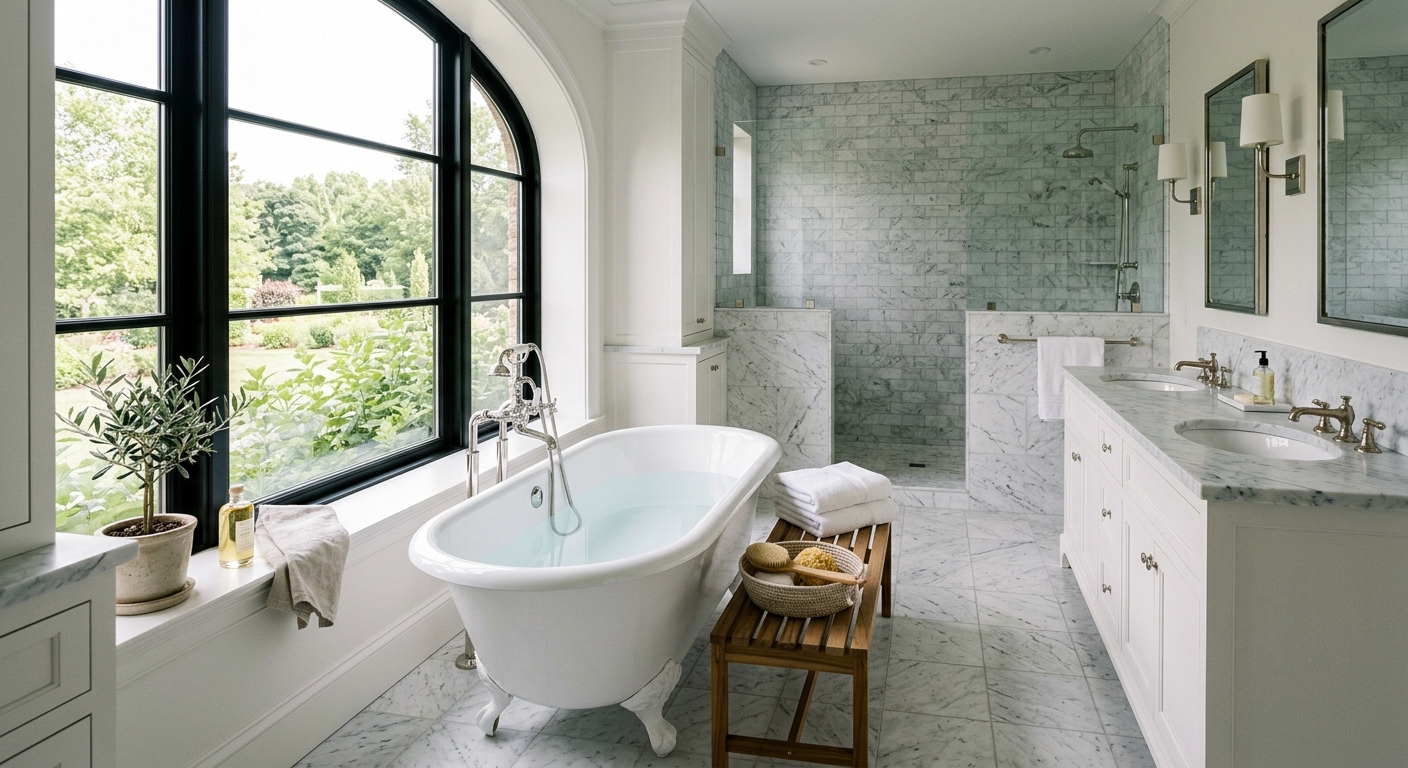
Bathroom renovation options and costs in Courtenay
Courtenay homeowners have a wide range of bathroom renovation options, from simple cosmetic refreshes to full remodels that gut down to framing and rework plumbing and electrical. In Courtenay, 30.2% of homes were built before 1981, and that age mix matters: older layouts often include legacy drain paths, dated venting, and sometimes materials that need careful handling. That’s why two bathrooms that look identical on paper can price very differently once walls are opened—especially if floor tile adhesives or drywall compounds contain asbestos in pre-1985 construction. (Statistics Canada, 2021 Census).
On Vancouver Island and the Coast, the climate is relatively mild, but it doesn’t remove the need for high-performance moisture control. Marine humidity and frequent temperature swings make ventilation and waterproofing non-negotiable, and they can add labour time if your existing fan ducting needs correction. The bigger cost driver is the local labour market: general contractors commonly price at $80–$120 per hour, while plumbers and electricians often land in the $100–$150 per hour range. With trades busy in higher-demand areas like downtown Courtenay and the Cumberland/Filberg area, schedules can tighten and discovery work during demolition can expand scope quickly.
Below are realistic budget bands so you can compare contractors apples-to-apples—then we’ll break down the specific cost drivers behind the numbers.
| Renovation Scope |
What's Included |
Typical Duration |
Price Range |
| Cosmetic refresh (paint, fixtures, accessories only) |
New vanity or faucet (no plumbing move), toilet reseat/replace, new lighting trims, paint, re-caulk, towel bars and accessories; existing tile kept |
2–5 days |
$3,000–$7,500 |
| Mid-range full renovation (new tile, vanity, tub/shower, electrical) |
Demo, waterproofing, floor + wall tile, new vanity, tub/shower set, exhaust fan upgrade, GFCI receptacle, updated trim/venting where needed |
2–3 weeks |
$12,000–$22,000 |
| High-end full renovation (custom tile, steam shower, heated floors) |
Custom shower or spa-style tub deck, premium tile layout and niche work, heated floors circuit, upgraded valves, designer fixtures, higher-spec waterproofing and glass |
3–5 weeks |
$22,000–$35,000 |
| Shower-only installation (convert tub to walk-in shower) |
Remove tub, prep subfloor, waterproofed shower assembly, new shower valve and head, glass option, updated drain slope/venting as required |
1–2.5 weeks |
$8,000–$15,000 |
| Bathtub replacement or tub-liner install |
New tub or quality liner system, wall surround rework, re-caulk and sealing, basic electrical/vent check (no major layout changes) |
5–10 days |
$1,500–$7,000 |
| Tile-only installation (floor + surround, existing layout kept) |
Tile removal (as required), new waterproofed tile floor + walls, proper backer/membrane, grout/seal, includes setting materials |
1–3 weeks |
$2,500–$10,000 |
Prices are estimates only and vary by project scope, site access and material selection.
What affects the price of bathroom renovation in Courtenay
If you get two quotes for what appears to be the “same” bathroom in Courtenay, it’s not unusual to see a 30–50% difference across Vancouver Island and Coast pricing—then add the broader British Columbia variability when contractors include different allowances for unknowns. The biggest contributors are regional labour rates and the age of the housing stock, not the weather. In Courtenay, where 50.1% of dwellings are single-detached homes and a meaningful portion were built before 1981, it’s common to discover hidden constraints during demo.
Older homes can hide cast-iron or older copper drain stacks that need partial replacement for correct slope, galvanized supply lines that don’t match today’s expectations, and insufficient fan ducting that can’t keep up with daily use. That’s why the Vancouver Island market often lands anywhere from mid-band full renovations (around $12,000–$22,000) up into higher-end builds (roughly $22,000–$35,000) once you factor in rough-in upgrades and proper ventilation.
As a concrete example, moving a drain a few inches to fix slope or changing the shower location typically triggers rough-in labour and inspection time, which can add several thousand dollars. Another example: upgrading from a basic exhaust fan to a properly ducted fan (and wiring a GFCI circuit where needed) can increase cost, but it’s usually justified because moisture control reduces repeat repairs.
In pre-1980 construction, asbestos-containing materials can show up in vinyl floor tile or older drywall compounds. When abatement is needed, it can quickly add $1,500–$5,000+ depending on containment scope—pushing cosmetic work into full renovation territory even when the layout stays the same.
| Price Factor |
Why It Matters |
Cost Impact |
| Layout change — moving drain or supply lines |
Requires opening walls/floor, replumbing and drainage slope corrections |
Often +$2,000–$8,000+ |
| Tile selection — large-format porcelain vs. mosaic vs. ceramic |
Material price and labour time increase with cuts, pattern work and substrate prep |
Often +$1,500–$6,000 |
| Fixture tier — builder-grade vs. mid-range vs. designer brands |
Valve quality, finish type, and trim pricing; sometimes different rough-in requirements |
Often +$500–$4,000 |
| Subfloor condition — rot or unlevel concrete adds scope |
May require framing repairs, membrane refinishing and additional waterproofing layers |
Often +$1,000–$5,000 |
| Electrical — adding GFCI outlets, exhaust fan, heated floor circuit |
Licensed electrical time and code-compliant parts; increases coordination |
Often +$800–$4,000 |
| Waterproofing method — membrane type and extent |
Better systems increase material cost but reduce failure risk |
Often +$600–$3,000 |
| Older-home surprises — asbestos tile, cast-iron drains, galvanized pipes |
May trigger abatement, partial pipe replacement, and added rough-in work |
Often +$1,500–$10,000+ |
| Bathroom size — sq ft drives tile and labour time directly |
Tile quantity, thinset/grout, and setting time scale with area |
Often +$1,000–$7,000+ |
Permits & regulations in British Columbia
In British Columbia, many “like-for-like” bathroom updates can be done without a permit. Cosmetic updates—such as swapping a vanity, replacing a faucet or toilet, repainting, or retiling in the same location—typically don’t require a permit because you aren’t moving plumbing lines or altering structural elements. However, permits do come into play when the work changes systems: relocating plumbing (moving a drain or supply line), installing or upgrading an exhaust fan where new wiring or ducting is required, and doing structural wall changes all generally require permitting and inspection.
Electrical work must meet provincial requirements and be done or signed off by a licensed electrician. That means if you’re adding heated floors, new lighting, or changing circuits, you should expect an electrical permit path. Plumbing rough-in changes—new valve locations, drain modifications, or venting adjustments—typically require a permit and inspection before walls close.
To verify a contractor in Courtenay step-by-step, ask for: (1) their BC trade licence (and confirm the trade is correct for the scope), (2) a current certificate of liability insurance, and (3) confirmation of worker coverage through WCB (workers’ compensation) for their employees. Request these documents directly from the contractor before signing. Also confirm the insurer and coverage dates match your project timeline, and keep copies in your file. If you’re dealing with older material removal and potential asbestos risk, confirm they’ll follow appropriate abatement practices and handle disposal properly.
Choosing tile, waterproofing and fixtures for your Courtenay bathroom
Your Courtenay bathroom budget is mostly shaped by three decisions: tile selection, waterproofing system, and fixture tier. First, tile: ceramic is usually the entry point, while porcelain costs more but handles moisture and impact better for floors and wet-wall areas. Natural stone can look premium, but it often adds labour complexity—varied materials can require more careful layout and sealing, and it may be more expensive to maintain over time.
Second, waterproofing: a paint-on membrane can work for some situations, but in real-world Vancouver Island conditions—daily showers, marine humidity, and temperature cycling—most long-lasting bathroom installs use a bonded sheet membrane or a proven system designed for tiled assemblies. A well-installed schluter-style approach (or equivalent engineered system) can provide a higher reliability barrier when floors and walls are properly prepared. The goal is preventing mould by stopping water intrusion and protecting the substrate beneath tile.
Third, fixtures: builder-grade units can reduce upfront cost, but mid-range valves and trims often improve long-term performance and resale appeal. If your homeowner household wants turnkey updates, upgrading visible fixtures can matter more than spending heavily in hidden areas.
Example: if you have a shower surround and you’re choosing between entry-level ceramic and porcelain, the extra material and setting time can be worth it when you’re already doing full demolition. A difference of a few thousand dollars inside a $12,000–$22,000 mid-range renovation is often justified because it reduces the risk of early grout failure and improves how the bathroom holds up to moisture.
| Material / Option |
Pros |
Cons |
Price Range |
| Ceramic tile (floor + walls) |
Good entry value, wide colour choices, straightforward maintenance |
Less forgiving under heavy traffic; more movement sensitivity if substrate prep is weak |
$2,500–$6,000 |
| Porcelain tile (floor + walls) |
Denser and more moisture-resistant, often more durable for floors and wet areas |
Higher material cost; may require more careful layout for large formats |
$4,000–$9,000 |
| Natural stone (marble, travertine, slate) |
High-end look; unique veining and texture |
Needs more sealing/maintenance; higher labour complexity and waste |
$7,000–$15,000 |
| Frameless glass shower enclosure |
Modern appearance, easy to clean, pairs well with custom tile |
Costs more; needs accurate measurements and solid waterproofed framing |
$2,500–$6,500 |
| Prefab tub surround (acrylic) |
Faster install, fewer tile-setting variables, good for budget conversions |
Less custom design control; seam and finish details matter |
$1,500–$4,000 |
| Custom shower pan (tile or linear drain) |
Best performance when done right; linear drains can improve look and usability |
More labour and waterproofing detail; requires precise slope and coordination |
$4,000–$12,000 |
How to choose a bathroom renovation contractor in Courtenay
Choosing the right contractor in Courtenay is about verification and clarity, not just price. Start by confirming British Columbia trade licensing for the trades they will perform or supervise, then request proof of liability insurance with coverage that matches the job value. For worker coverage, verify their WCB clearance (workers’ compensation) applies to their employees. In practice, you can check these by asking for a licence number, a current certificate of insurance, and a clearance letter or policy verification they can provide for your dates.
Next, get 2–3 itemised written quotes—not a single lump-sum that hides risk. You want line items for labour and materials (demo, plumbing/electrical allowances, waterproofing system, tile setting, disposal, and any permit-related tasks). Read the scope carefully for exclusions: what happens if they open the wall and find out-of-code venting, rot, or older pipe materials? Clarify whether asbestos-related discovery handling is included, and whether disposal is included in the price or billed separately.
Warranty matters too. Ask for workmanship warranty length (often separate from manufacturer product warranty), confirm what is covered, and whether it’s transferable if you sell your home. For payment schedule, never agree to more than about 10–15% upfront. Hold back a portion until punch list items and final cleanup are complete. Finally, require a start date and completion estimate in writing, with key milestones for demo, rough-in, waterproofing, and trim.
- Verify BC licence numbers match the trades in the scope.
- Request current liability insurance and confirm policy dates.
- Confirm WCB clearance applies to the contractor’s workforce.
- Get itemised quotes (labour + materials), not just a total.
- Confirm whether permits and inspections are included or separate.
- Clarify disposal: demolition debris hauling included or extra?
- Ask who is responsible for plumbing/electrical rough-in changes if discovered.
- Confirm the waterproofing method by name (membrane system, coverage, and transitions).
- Ask for a tile setting approach for your substrate (backer or membrane over subfloor).
- Require a written warranty for labour and check manufacturer warranty terms.
- Use a payment schedule with a holdback until final completion.
- Schedule a walkthrough for measurements before ordering glass and fixtures.
In Courtenay, red flags I see often: (1) quotes that ignore venting/fan upgrades despite an older home, (2) no written waterproofing specification, (3) “we’ll figure it out later” language around permits or electrical scope, (4) large upfront deposits beyond 15%, and (5) no clear warranty terms or no documented insurance/WCB proof.
Frequently asked questions — bathroom renovation in Courtenay
How long does a bathroom renovation take in Courtenay?
In Courtenay, timelines depend heavily on whether you’re doing a cosmetic refresh or a full renovation with rough-in changes. A cosmetic refresh is often completed in about 2–5 days, assuming fixtures are on site. A mid-range full renovation typically takes about 2–3 weeks when plumbing/electrical, waterproofing and tile are sequenced cleanly. For shower conversions and shower-only work, many projects land around 1–2.5 weeks. If you’re moving fixtures, upgrading electrical for heated floors, or dealing with older-home surprises, it can stretch to 3–5 weeks. Materials and scheduling with trades in the Vancouver Island and Coast region also influence completion dates.
Do I need a permit for a bathroom renovation in British Columbia?
In British Columbia, many cosmetic bathroom updates usually don’t require a permit—like swapping a vanity, replacing a toilet, repainting, or retiling without changing plumbing locations. You typically do need permits when you change the systems: relocating plumbing (moving drain or supply lines), installing or upgrading exhaust fans where new circuits/ducting are involved, and making structural wall changes. Electrical work must comply with provincial code and be done or signed off by a licensed electrician, which often triggers permitting depending on what’s being added (like GFCI outlets or heated floor circuits). If your home is older—remember, 30.2% of Courtenay-area homes were built before 1981—plan for inspection steps once walls open.
What's the best tile for a bathroom in Courtenay?
The “best” tile depends on what parts you’re tiling and how your bathroom is used, but for Courtenay bathrooms, porcelain is usually the safest middle-to-premium choice for floors and wet walls. Ceramic tile can be a good entry point, yet porcelain generally performs better in moisture-heavy areas due to its density and strength. Natural stone looks luxury-high, but it can require more maintenance like sealing, and selection should match your lifestyle. Whichever you choose, the real difference in long-term performance comes from waterproofing and substrate prep, not just the tile name. If you’re targeting a mid-range project around $12,000–$22,000, investing in porcelain and a proven waterproofing system is typically a strong value.
Should I do a tub-to-shower conversion?
In Courtenay, tub-to-shower conversions are popular because they modernize the bathroom and improve accessibility. A conversion also fits well if your tub is aging, caulking is failing, or you want easier daily use. However, conversions can cost more than a simple refresh because removal, drainage slope work, and new shower valve arrangements may require extra rough-in labour. Typical shower installation budgets in this market often fall around $4,000–$15,000 depending on enclosure type and waterproofing scope; a realistic shower-only conversion frequently aligns with the $8,000–$15,000 band. If you’re in a pre-1981 home, expect that hidden plumbing or venting issues may appear once demolition starts—this is where good contractor planning helps.
How do I prevent mold in a Courtenay bathroom?
Mould prevention is mostly about keeping water from getting into concealed areas and ensuring moisture is exhausted quickly. Start with waterproofing: use a proper tiled assembly with the correct membrane system and transitions at corners, niches and floor-to-wall joints. Next, ventilation matters—upgrading the exhaust fan and ensuring ducting is correctly vented can make a big difference in a coastal climate where humidity lingers. Also ensure correct caulking around the tub/shower and that grout is sealed where the chosen system requires it. Finally, address substrate issues: if the subfloor is unlevel or has rot, moisture can move and stress the waterproofing. In older homes, hidden plumbing leaks can also cause mould, so ask the contractor how they’ll check for pressure and drainage issues during the rough-in stage.
What adds the most resale value in a bathroom reno?
Resale value in Courtenay typically comes from improvements that are visible, durable, and aligned with today’s expectations for ventilation and safety. The biggest wins are a clean, modern layout; quality waterproofing; and dependable fixtures—especially upgraded exhaust ventilation and code-compliant electrical (like GFCI protection). Tile quality matters, but buyers often care more that the bathroom feels “done properly” (no recurring leaks, no soft subfloor, and no lingering odours) than whether it’s the most expensive stone. In a mid-range renovation, you may land around $12,000–$22,000, and that range is often where homeowners get noticeable, market-friendly improvements. For higher-end budgets (roughly $22,000–$35,000), features like heated floors, premium glass, and custom showers tend to pay off if the finish is cohesive.