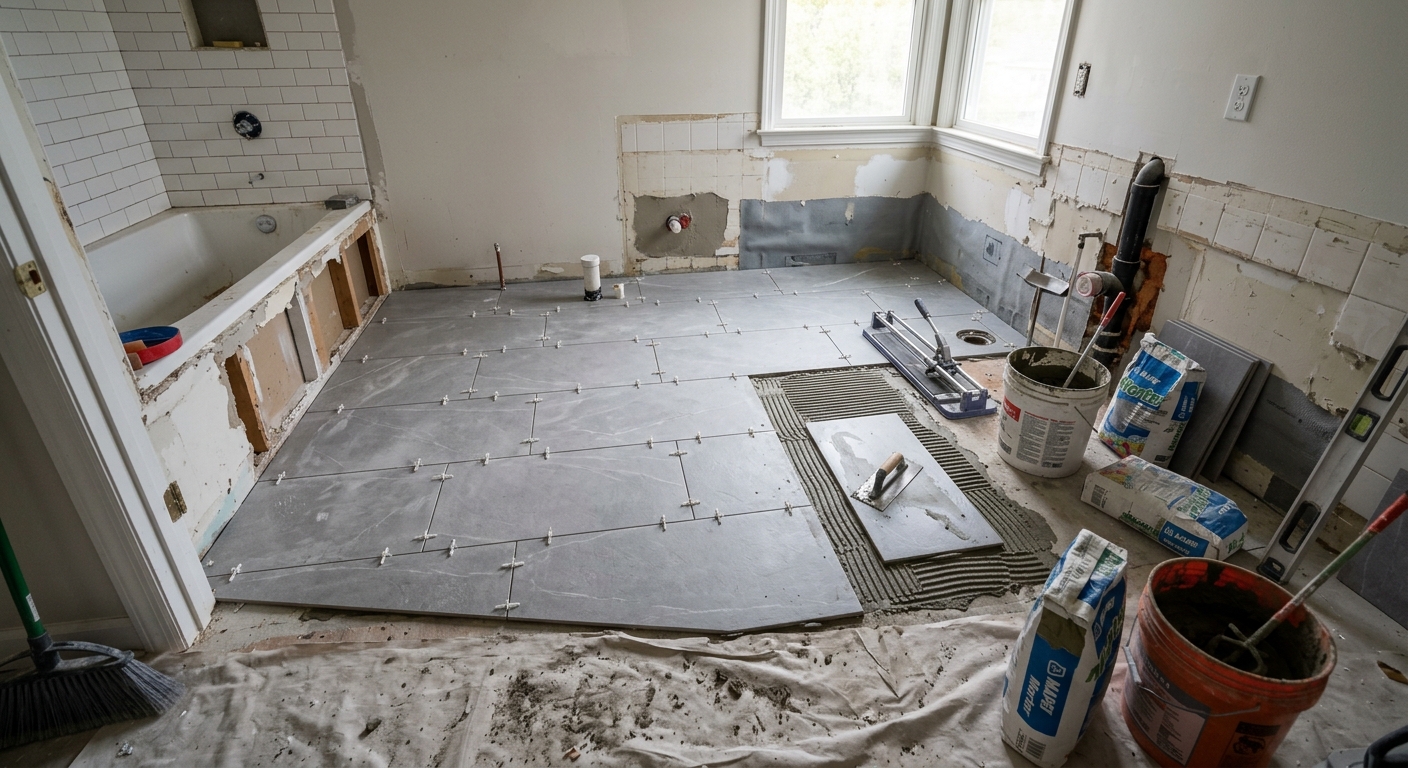
Bathroom renovation options and costs in Campbell River
In Campbell River, bathroom renovations range from simple refreshes to full rebuilds, and the price gap is often driven more by the age of the home than by the mild maritime weather. With 40.0% of homes built before 1981, many local bathrooms sit inside dated plumbing layouts, older drain assemblies, and sometimes floor materials that may contain asbestos in older flooring or drywall compounds. On top of that, Vancouver Island and the Coast market has a contractor availability challenge: when trades are busy, schedules tighten and labour costs rise because skilled plumbers, electricians, and tile setters are booked first. The region’s labour structure also matters—general contractors commonly bill in the 80–120 per hour band, while plumbers and electricians often land in the 100–150 per hour range—so labour becomes the largest line item on a bathroom project.
In neighbourhoods like Willows and along the North Island Highway corridor, we frequently see older homes where once the walls open, legacy venting, galvanized supply lines, or cast-iron/copper drain components come to light. That “hidden conditions” moment is why two homeowners can receive quotes for the same-looking job that land in very different spots within the $10,000–$35,000 full-renovation band. Once scope is defined, material choices still matter—tile labour, waterproofing system complexity, and glass enclosures add up fast in a wet room.
Use the table below to compare typical scopes and where most Campbell River budgets land before you request itemised pricing.
| Renovation Scope |
What's Included |
Typical Duration |
Price Range |
| Cosmetic refresh (paint, fixtures, accessories only) |
Paint, new vanity top or vanity swap (no plumbing relocation), new taps/controls, towel bars, mirrors, toilet accessory replacements; may include minor caulking and trim work |
3–7 days |
$2,000 – $6,500 |
| Mid-range full renovation (new tile, vanity, tub/shower, electrical) |
Demo and disposal, updated waterproofing in wet zones, ceramic/porcelain tile on floors and walls, new vanity, new tub/shower unit or surround, exhaust fan upgrade, GFCI where required, basic lighting refresh |
2–4 weeks |
$15,000 – $25,000 |
| High-end full renovation (custom tile, steam shower, heated floors) |
Full demo to rough-in as needed, premium waterproofing system, custom large-format tile layout, heated floors circuit, frameless glass, steam-ready or steam shower components, upgraded electrical package, upgraded trim and ventilation |
4–7 weeks |
$28,000 – $45,000 |
| Shower-only installation (convert tub to walk-in shower) |
Remove tub, rough-in adjustments as needed, new shower pan or pan build-up, waterproofing, tile surround, curb or niche options, new glass door, updated exhaust fan connection |
2–3 weeks |
$10,000 – $18,500 |
| Bathtub replacement or tub-liner install |
Swap tub (or install liner where applicable), reseal waterproof surfaces, set new surround material, re-connect plumbing, reglaze/replace trim, minor drywall and painting |
5–12 days |
$1,800 – $7,000 |
| Tile-only installation (floor + surround, existing layout kept) |
Tile removal where needed, prep, waterproofing at wet areas, tile installation (existing fixture locations retained), grouting/sealing as required |
1–3 weeks |
$2,500 – $10,000 |
Prices are estimates only and vary by project scope, site access and material selection.
What affects the price of bathroom renovation in Campbell River
Two bathroom quotes that look identical on paper can differ by 30–50% across Vancouver Island, other parts of BC, and even within the same city. In practice, the main drivers are regional labour rates and how old the local housing stock is—not the climate itself. Campbell River sits on the North Island and the Coast market, where older homes are common (40.0% built before 1981), and that increases the odds of discovery work once walls and floors are opened. Expect more variations from one contractor to another when legacy plumbing exists: hidden cast-iron or copper drains may need upgrading, galvanized supply lines can require replacement, and older venting may not pull moisture adequately.
When asbestos is found in older floor tile or older drywall compound (more likely in pre-1985 construction), budgets rise because abatement, containment practices, and specialized disposal can add $1,500–$5,000+ depending on the area and access. Electricity can also change a project’s path: adding or upgrading exhaust fans, updating GFCI protection, or running new circuits for heated floors is labour-intensive, particularly in tight bathrooms where chasing walls is required. That’s why many Campbell River renovations cluster within the $10,000–$35,000 full-renovation range—especially when a “simple tile job” evolves into rough-in fixes.
Here are a few examples we see locally. If you keep the plumbing layout and select ceramic over porcelain, you may stay closer to the $2,500–$10,000 tile-only band. If you convert a tub to a walk-in shower and need drain rework plus improved ventilation, budgets more commonly land in the $10,000–$18,500 shower-installation band. Finally, larger bathrooms increase tile quantities and labour time directly, often nudging projects up even with the same finish level.
| Price Factor |
Why It Matters |
Cost Impact |
| Layout change — moving drain or supply lines requires rough-in work |
Relocating plumbing means opening walls/floors, adding blocking, rerouting pipe runs, and new testing/inspection steps |
Often adds $2,500 – $8,000+ |
| Tile selection — large-format porcelain vs. mosaic vs. ceramic |
Harder tile types require careful cutting, more premium thinset/prep, and tighter tolerances |
Typically adds $1,000 – $6,000 |
| Fixture tier — builder-grade vs. mid-range vs. designer brands |
Higher-end fixtures cost more, and installation may include extra framing/valves or more complex finishes |
Varies by $800 – $4,500 |
| Subfloor condition — rot or unlevel concrete adds scope |
Loose subfloor or deterioration requires reinforcement, re-leveling, and sometimes membrane transitions |
Often adds $1,200 – $5,000+ |
| Electrical — adding GFCI outlets, exhaust fan, heated floor circuit |
New wiring runs and fan upgrades drive licensed labour and component costs |
Typically adds $800 – $6,000+ |
| Waterproofing method — membrane type and extent |
Better membranes (and correct detailing) add material/labour but reduce moisture-risk callbacks |
Typically adds $500 – $3,500 |
| Older-home surprises — asbestos tile, cast-iron drains, galvanized pipes |
Discovery triggers extra demolition control, potential abatement, and replacement of older components |
Often adds $1,500 – $10,000+ |
| Bathroom size — sq ft drives tile and labour time directly |
Tile is priced per project with labour for layout, cuts, and cure time; larger rooms take longer |
Commonly shifts $1,500 – $8,000+ |
Permits & regulations in British Columbia
In British Columbia, the permit need depends on what changes in your Campbell River bathroom. Cosmetic updates—like swapping a vanity, replacing taps, retiling within the same footprint, or painting—typically do not require permits as long as you’re not moving plumbing, changing structural elements, or altering electrical work beyond what’s permitted under standard fixture swaps. However, when you relocate plumbing lines (moving a drain or supply), add a new exhaust fan, run new electrical circuits (for example, heated floors), or make structural changes (altering framing or supporting walls), permits and inspections are commonly required. Electrical work also must meet BC code and be done or signed off by a licensed electrician.
A practical approach for homeowners is step-by-step verification before work starts. First, ask the contractor to provide their BC trade licence number and the company name that matches the licence. Second, request a Certificate of Insurance showing general liability coverage for the project duration; read the expiry date and ensure it lists the work location. Third, confirm workers’ coverage through WCB (commonly referred to as WCB in BC) for employees—if a contractor is not properly covered, you may be exposed if an incident occurs on-site.
To check quickly in Campbell River: verify licence details against the online registry, review the COI for coverage limits and project address, and ask for a WCB clearance/confirmation letter or documentation. If the scope includes plumbing rough-in changes, request confirmation that the permit process will be handled before any walls close.
Choosing tile, waterproofing and fixtures for your Campbell River bathroom
Choosing finishes in Campbell River is less about “style” and more about building a wet-area system that performs reliably in a coastal climate where bathrooms see frequent moisture. The three biggest budget levers are tile choice, waterproofing method, and fixture tier—because they change both material costs and how much skilled labour is required.
First, tile: ceramic is a solid entry option for floors and wall surrounds, but it can be less dimensionally forgiving and typically carries a simpler installation profile. porcelain costs more but offers better durability and often tighter consistency for cleaner layouts, especially with larger formats. For a luxury look, natural stone (marble, travertine, slate) can be stunning, but it can require extra prep, careful sealing, and slower installation due to variations. For waterproofing, your method is the real mould-control decision. In BC bathrooms, we generally see the best long-term results with a properly detailed bonded sheet membrane or a high-quality waterproofing system (including correct transitions at corners, niches, and tub/shower interfaces). Paint-on membranes can work when rated for the application and installed correctly, but they rely heavily on surface prep and application diligence.
Fixture tier affects both budget and resale. Builder-grade fixtures reduce upfront costs, while mid-range or designer brands often improve long-term satisfaction through smoother valves, better finishes, and more consistent warranties.
Budget example: if you’re deciding between ceramic vs. porcelain, the difference can be meaningful. On a typical mid-size bathroom, moving from ceramic to porcelain can add roughly $1,500–$3,500 in materials and installation labour, and it can be worth it if you’re using larger tiles that reduce visual seams and if your waterproofing detailing requires a more precise substrate for best results.
| Material / Option |
Pros |
Cons |
Price Range |
| Ceramic tile (floor + walls) |
Entry-friendly cost, wide style selection, easy to source locally, good for standard wet-area installs when paired with proper waterproofing |
Less durable than porcelain in high-traffic areas, more variation across batches can increase layout time |
$2,500 – $7,000 |
| Porcelain tile (floor + walls) |
Denser and more durable, often better for larger formats, holds up well to cleaning and daily use |
Higher material cost, heavier tile needs careful handling and more precise substrate prep |
$4,500 – $10,000 |
| Natural stone (marble, travertine, slate) |
Premium, unique look; adds a high-end feel to Campbell River homes |
More maintenance (sealing), higher labour due to variation and cutting, can cost more for matching pieces |
$8,000 – $18,000 |
| Frameless glass shower enclosure |
Modern appearance, helps visually open smaller bathrooms, clean lines with better perceived value |
Must be accurately measured and installed; can raise cost if custom sizes or complex hinges are needed |
$3,000 – $8,000 |
| Prefab tub surround (acrylic) |
Fast install, consistent finish, good for keeping disruption lower than full tile surrounds |
Less “designer” look than full tile, seams and edges must be properly sealed for longevity |
$1,200 – $4,500 |
| Custom shower pan (tile or linear drain) |
Best performance when done with the right waterproofing and slope; linear drains look upscale and minimize standing water |
Slower build and more detailing time; more exacting waterproofing transitions |
$4,000 – $15,000 |
How to choose a bathroom renovation contractor in Campbell River
Choosing the right contractor in Campbell River is about proving they can handle both the visible finishes and the hidden rough-ins that older homes often reveal. Start with British Columbia licensing. Ask for the contractor’s trade licence (if applicable to their trade), the company name that matches the paperwork, and their liability coverage. For insurance, request a Certificate of Insurance before scheduling—review the coverage limits and confirm the work address is included or the policy is valid for your project start/end dates. Next, confirm WCB (workers’ compensation) coverage for their employees. If a contractor doesn’t have WCB documentation or insurance, treat it as a major risk for you and your property.
Then get 2–3 itemised written quotes. You want line items that separate labour and materials (demo/disposal, rough-in, waterproofing system, tile setting, electrical, glass, trim, painting). Avoid lump-sum quotes that don’t say what brand/product is included. Read the scope for exclusions: disposal (what’s hauled away), permit pull responsibility, patch/paint scope, and whether subfloor prep is included.
Finally, confirm warranty details. Ask for (1) a workmanship warranty length and what it covers, (2) manufacturer/product warranty for waterproofing, fixtures, and glass, and (3) whether the warranty is transferable to future owners—this matters for resale.
- Ask for a written start date, work schedule, and target completion date
- Confirm which trade(s) are licensed for electrical and plumbing rough-in
- Require an itemised quote: labour vs materials, not just “total price”
- Verify waterproofing system brand/model is named in the quote
- Clarify if tile backer/substrate prep is included
- Check whether demolition and disposal are included (and how much)
- Confirm whether permits/inspections are pulled by the contractor or by you
- Ask for disposal method and protection of flooring/doorways during demo
- Review payment schedule: never more than 10–15% upfront
- Hold back a portion until the job is complete and inspected (if applicable)
- Get warranty terms in writing and confirm who you call after completion
- Ask how change orders are priced and how surprises are handled
In Campbell River, common red flags include quoting without site inspection, refusing to provide licence/insurance/WCB documentation, vague waterproofing descriptions, missing exclusions in the scope (especially disposal and patch/paint), and payment requests that exceed 10–15% before any measurable work begins.
Frequently asked questions — bathroom renovation in Campbell River
Do I need a permit for a bathroom renovation in British Columbia?
In Campbell River and across British Columbia, cosmetic changes often don’t need permits—typical examples are swapping fixtures, painting, or retiling within the same layout where you’re not moving plumbing or altering structure. Permits are more likely when you relocate plumbing (moving drain or supply lines), add or relocate an exhaust fan with electrical work, change lighting circuits, or make structural changes. Electrical work must follow BC code and be completed or signed off by a licensed electrician. A good contractor will confirm what triggers a permit before walls are opened and will include inspections as part of the plan. If you’re staying within a tile-only or cosmetic refresh scope, your project may avoid permits, but a tub-to-shower conversion frequently increases rough-in activity.
What's the best tile for a bathroom in Campbell River?
For Campbell River bathrooms, the “best” tile is the one that fits your wet-area system and your maintenance preferences. If you want durability with a strong cost-to-performance balance, porcelain tile is usually the top choice for floors and walls because it’s dense and handles daily wear well. Ceramic can be a good entry option for less demanding use, and many homeowners keep budgets in the $2,500–$10,000 tile-only band by choosing ceramic with solid waterproofing. Natural stone looks luxurious but needs careful sealing and slower installation—so it’s typically reserved for higher-end budgets. Regardless of tile type, the waterproofing method and correct detailing at corners, niches, and the tub/shower interface matter more than brand name alone in terms of preventing moisture issues.
Should I do a tub-to-shower conversion?
For many homeowners in British Columbia, a tub-to-shower conversion makes sense because it improves accessibility and often shortens future maintenance headaches. In older homes built before 1981 (40.0% in the area, per Statistics Canada, 2021 Census), conversions can also reveal whether your drain venting and existing plumbing layout are dated—meaning the scope might grow once walls open. Pricing typically ranges within the shower installation band: many projects land in the $10,000–$18,500 range depending on whether plumbing rough-in and improved ventilation are required. If you keep the plumbing layout and choose a straightforward shower pan with standard finishes, it can be a controlled-cost option. If you change layout or add upgraded glass and linear drain features, budget toward the upper end.
How do I prevent mold in a Campbell River bathroom?
Mould prevention in Campbell River is mostly about preventing moisture from staying in the wrong places. Start with a properly installed waterproofing system in the wet zones (shower walls, floor, and transitions), with correct curing time before tiling. Next, make sure your exhaust fan is correctly sized and vented—older bathrooms often have inadequate fan performance, and that can be a hidden issue once you open walls. Use bathroom-rated caulking at wet-area edges and avoid gaps around fixtures. Keep grout sealed where your tile system calls for it, and choose surfaces that don’t trap water. Finally, ventilation habits matter: run the fan during and after showers, and wipe standing water if needed. In older homes, upgrading ventilation and addressing potential legacy plumbing is often the best “first fix” for long-term mould control.
What adds the most resale value in a bathroom reno?
In Campbell River and across Vancouver Island, buyers tend to reward bathrooms that look updated and function reliably. That typically means a clean waterproofed shower area, modern lighting, and a properly ventilated room—more than it does ultra-luxury finishes. A mid-range full renovation (often in the $15,000–$25,000 range) usually provides the strongest value-per-dollar when the contractor addresses moisture-risk details and upgrades key mechanical components. If your home is older (40.0% built before 1981), fixing ventilation, updating electrical safety (like GFCI protection where required), and improving the shower build quality can make your reno feel “new” in a way superficial cosmetic work can’t. Premium choices like heated floors and frameless glass can help at higher price points, but they add the most value when the underlying waterproofing and rough-in work are done correctly.
Can I keep my existing plumbing layout to save money?
Yes—keeping the existing plumbing layout is one of the most reliable ways to reduce renovation cost in Campbell River. When you don’t move drains or supply lines, you avoid a lot of rough-in work, drywall opening, and re-testing that can push budgets upward quickly. That said, older homes may still need repairs even if the layout stays the same: for example, galvanized supply lines or older drain components can fail during removal and reinstall. If your plan is mainly tile and fixture updates, you can often target the tile-only or mid-range cosmetic territory and keep spending closer to the $2,500–$10,000 tile-only band. If you’re doing a full renovation or converting a tub to a shower, confirm how much plumbing adjustment is truly required before committing—some “simple swaps” turn into full rough-in once the contractor exposes the legacy system.