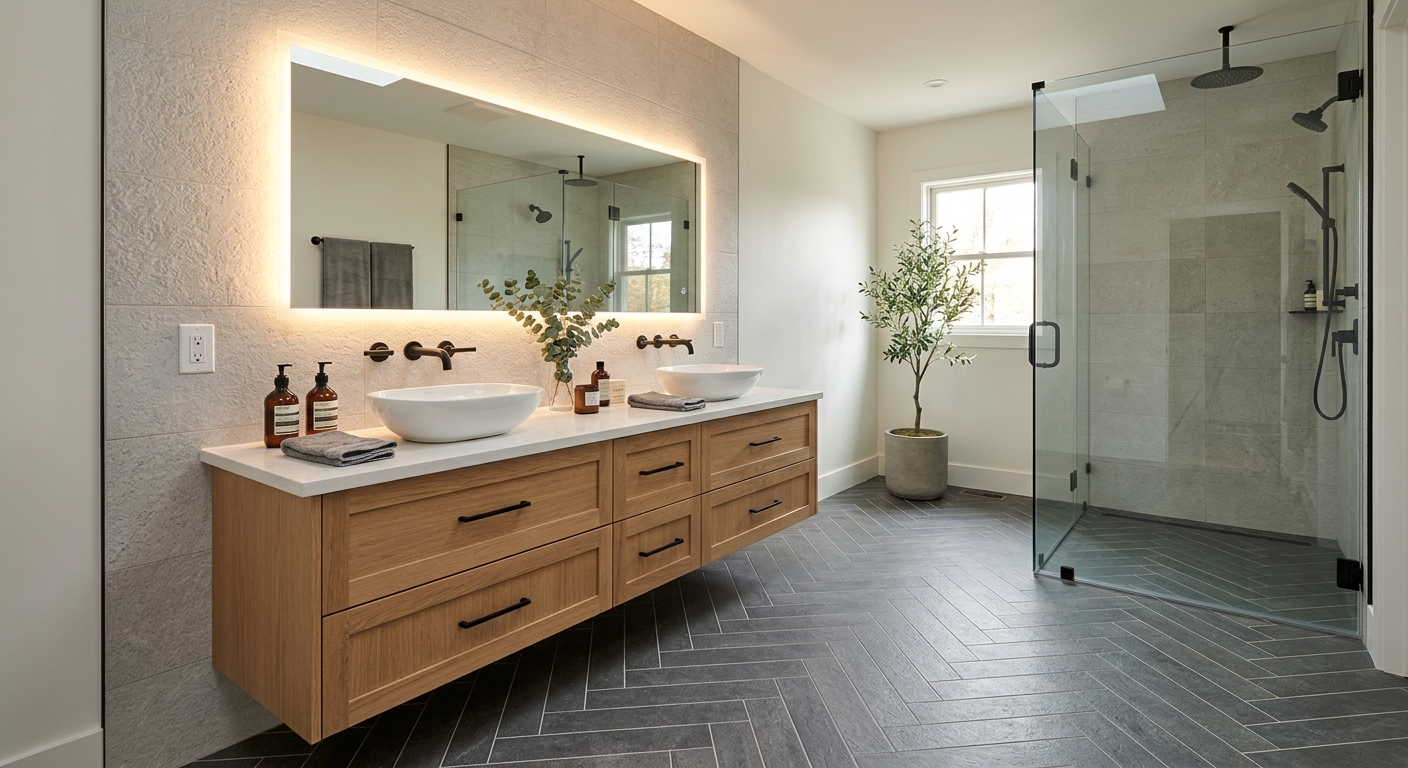
Bathroom renovation options and costs in Valleyview
Bathroom renovation in Valleyview has a pretty wide cost range, mostly because tradespeople are dealing with different levels of hidden rework behind the walls. With 46.2% of Valleyview’s housing stock built before 1981, many renos start with dated rough-ins and older drain assemblies that don’t always line up cleanly with modern fixtures. You’ll also see higher variance because 57.6% of homes are single-detached, which often means full-bath work is on the critical path for busy households, and contractors get pulled in multiple directions across the Athabasca–Grande Prairie–Peace River region. That demand is shaped less by “weather” and more by the region’s labour market and the frequency of plumbing/venting upgrades in older homes—especially where cast-iron drains or copper supply runs show their age.
In practical terms, a cosmetic refresh can be straightforward, while a full renovation in an older Valleyview home often becomes a sequence of demolition, rough-in upgrades (plumbing + electrical), then waterproofing and tile. In areas with more older homes—often around the older residential pockets near Valleyview’s downtown/core area—expect contractors to budget time for venting checks and subfloor assessment. If asbestos-containing materials are uncovered, abatement and safe disposal can change both schedule and total cost.
Below are the common options homeowners compare when requesting quotes in Valleyview, so you can line up scope before you start price-shopping.
| Renovation Scope |
What's Included |
Typical Duration |
Price Range |
| Cosmetic refresh (paint, fixtures, accessories only) |
New paint, toilet/vanity top replacement (if staying in same positions), faucet, light fixture swaps, towel bars/accessories, caulking, deep clean |
2–5 days |
$2,500–$6,500 |
| Mid-range full renovation (new tile, vanity, tub/shower, electrical) |
Demo + rebuild, new waterproofing, floor + tub surround tile, new vanity and mirror, tub or tub/shower refresh, exhaust fan and GFCI, basic plumbing adjustments as needed |
2–4 weeks |
$14,000–$24,000 |
| High-end full renovation (custom tile, steam shower, heated floors) |
Custom layout refinements, premium waterproofing, large-format tile/stone-look porcelain, heated floor system, frameless glass, steam-ready shower components, upgraded electrical for heated loads |
4–7 weeks |
$24,000–$32,000 |
| Shower-only installation (convert tub to walk-in shower) |
Demo tub, modify rough-in, new shower pan/waterproofing, floor + wall tile to ceiling or specified height, new shower valve/trim, exhaust fan check, disposal |
1–3 weeks |
$8,000–$18,000 |
| Bathtub replacement or tub-liner install |
Remove old tub (or prep for liner), new tub, re-caulk/new seals, minor plumbing tie-ins, leak test, trim replacement where needed |
3–10 days |
$1,500–$9,000 |
| Tile-only installation (floor + surround, existing layout kept) |
Tile demo (as required), new floor + shower/tub surround tile, waterproofing up to recommended system coverage, grout + sealers, basic rework to match existing fixtures |
1–2 weeks |
$6,000–$16,000 |
Prices are estimates only and vary by project scope, site access and material selection.
What affects the price of bathroom renovation in Valleyview
Two quotes for the “same” bathroom in the Athabasca–Grande Prairie–Peace River region can easily land 30–50% apart because the cost drivers are usually labour and hidden-condition scope, not the finish you can see. Alberta renos are labour-leaning: trades demand is strong, and resource-sector wages can pull skilled plumbers, electricians and tile setters into higher hourly rates. On top of that, Valleyview’s older housing profile—46.2% of homes built before 1981—means you’re more likely to uncover cast-iron or aged drain stacks, older supply piping, or insufficient venting that has to be corrected before walls close back up.
In older bathrooms, even a “straight swap” can expand into rough-in changes. For example: an exhaust fan that doesn’t vent properly, a flange/pipe mismatch, or venting that’s undersized can add hours—and if you need plumbing and venting upgrades, that can double typical plumbing allowances. Another common scope changer is asbestos risk: in pre-1985 homes, discovering asbestos-containing vinyl floor tile or related materials triggers professional abatement protocols. Budgeting an extra $1,500–$5,000+ for that contingency is prudent; otherwise, the project can stall mid-build.
Concrete examples I see in Valleyview: (1) switching from a basic tub surround to full-height tile increases both tile quantities and waterproofing coverage; (2) choosing large-format porcelain often looks faster but requires careful prep of subfloor and lippage control; (3) keeping the same layout keeps your price closer to the $14,000–$32,000 full-renovation band, while moving drains/supplies tends to push the job upward even if fixtures stay mid-range.
The key is that “climate” matters mostly for moisture control, while the biggest cost variance here comes from what’s behind the drywall—especially in older Valleyview homes.
| Price Factor |
Why It Matters |
Cost Impact |
| Layout change — moving drain or supply lines |
Requires rough-in work, patching framing/subfloor, and leak-proofing rework |
Often adds $3,000–$10,000 depending on re-routing |
| Tile selection — large-format porcelain vs. mosaic vs. ceramic |
Different cutting complexity, prep needs, and setting time |
Typically adds $1,500–$6,000 |
| Fixture tier — builder-grade vs. mid-range vs. designer brands |
Higher fixtures cost more and may require different valves/rough-in parts |
Can swing $1,000–$7,000 |
| Subfloor condition — rot or unlevel concrete adds scope |
Weak substrate forces removal/replacement and increases waterproofing prep |
Often adds $1,000–$8,000 |
| Electrical — adding GFCI outlets, exhaust fan, heated floor circuit |
May require new circuits and code-compliant fan installation/venting |
Commonly adds $500–$4,000 |
| Waterproofing method — membrane type and extent |
Better systems reduce long-term moisture failure risk |
Typically adds $300–$2,500 but prevents costly redo |
| Older-home surprises — asbestos tile, cast-iron drains, galvanized pipes |
Hazard remediation and replacement rough-in increases labour and timeline |
Often adds $1,500–$12,000+ |
| Bathroom size — sq ft drives tile and labour time directly |
More surface area increases tile, waterproofing, setting time |
Can shift total by $2,000–$8,000 |
Permits & regulations in Alberta
In Alberta, many bathroom updates are considered cosmetic. Swapping a vanity, replacing a toilet, changing a light fixture, updating a mirror, re-grouting, and re-caulking typically do not require permits because you’re not altering plumbing rough-ins or structural elements. However, in Valleyview and across Alberta, the work that usually does require a permit includes relocating plumbing (moving the drain or supply lines), adding new or relocating electrical circuits/outlets (including GFCI changes where circuit work is involved), installing or changing exhaust ventilation with new ducting and electrical connections, and any structural wall changes that affect framing or openings.
Any electrical work must be done by a licensed electrician or signed off by one, and plumbing rough-in changes generally require an inspection after rough-in and before close-up. Before work begins, ask your contractor to confirm which permits they’ll pull and whether they’ll schedule inspections (permits and inspections should be clearly stated in the written scope).
To verify a contractor in Valleyview, start by (1) checking their Alberta trade licence status via the appropriate provincial online registry for their trade, (2) requesting a certificate of liability insurance and confirming it covers renovation work at your address, and (3) asking for proof of workers’ compensation coverage (WSIB/WCB) where applicable for their crew. Then ask for a clearance letter or coverage confirmation so you’re not left holding risk if a worker is injured on your site.
Good contractors are comfortable providing this documentation up front, not after you sign.
Choosing tile, waterproofing and fixtures for your Valleyview bathroom
In Valleyview, your three biggest material decisions are tile, waterproofing, and fixtures—because each affects not just the look, but how long the bathroom stays trouble-free. First, tile choice: ceramic tile is the entry point and can work well for some wall applications, but porcelain is denser and typically performs better in humid wet areas. Natural stone (marble, travertine, slate) creates a high-end look, yet it requires proper sealing and meticulous install planning. The installation complexity varies too: porcelain and large-format tiles demand accurate substrate prep and careful thinset coverage.
Second, waterproofing method: paint-on membranes can be acceptable for certain systems, but for most tub/shower surrounds you’ll get the best confidence with a bonded sheet membrane or a compatible schluter-style system approach. In Alberta, the goal isn’t “dry air”—it’s reliable protection against repeated wetting and fast turnarounds between showers. When waterproofing is rushed or coverage is incomplete, mould growth and grout failure are the usual symptoms, often showing up months after the renovation.
Third, fixture tier: builder-grade fixtures cost less but may limit adjustability and finish durability; mid-range strikes a balance, especially when you choose valves and trims designed for smooth long-term use. Designer brands can be worth it if you love the aesthetics and are also keeping the plumbing rough-in simple (no moving drains/supplies).
For a real budget example: if you’re deciding between standard tile and a premium waterproofing/membrane upgrade, spending an extra $800–$2,000 on a proven waterproofing system is often justified when you’re already in the $14,000–$24,000 renovation band and the walls will be opened anyway. Cutting waterproofing costs is usually the wrong place to save—especially in older Valleyview homes where hidden prep issues are common.
| Material / Option |
Pros |
Cons |
Price Range |
| Ceramic tile (floor + walls) |
Good value, wide style selection, straightforward in many layouts |
More prone to chipping; may require careful slope/grout detailing for floors |
$2,000–$6,000 |
| Porcelain tile (floor + walls) |
Durable, moisture-resistant, better for wet zones; handles heavy foot traffic well |
Can cost more; large-format needs excellent flatness and prep |
$4,000–$10,000 |
| Natural stone (marble, travertine, slate) |
Premium look and uniqueness; great for statement floors and niches |
Sealing/maintenance required; higher labour for fit and finishing |
$8,000–$18,000 |
| Frameless glass shower enclosure |
Modern look, brightens the space, easier to clean than framed units |
Requires precise framing/leveling; higher risk if substrate prep is poor |
$3,000–$9,000 |
| Prefab tub surround (acrylic) |
Fast install; clean lines; fewer tile joints to grout/maintain |
Limited design choices; edge detailing still needs proper waterproofing |
$1,200–$4,500 |
| Custom shower pan (tile or linear drain) |
Upscale look and better drainage; works well with full-height tile |
More labour; requires top-quality slope and waterproofing detailing |
$4,000–$14,000 |
How to choose a bathroom renovation contractor in Valleyview
When you’re hiring a bathroom contractor in Valleyview, verification matters as much as price. Start with Alberta licensing for the relevant trades (plumbing and electrical are the big ones in bathrooms), and ask for proof of liability insurance plus workers’ compensation coverage for their crew (WSIB/WCB). To check each item, don’t rely on a one-page brochure—ask for the certificate of insurance to match the company name doing the work, confirm policy dates, and request the clearance/coverage confirmation. For licences, use the provincial online registry for the contractor’s trade category so you’re confirming the exact business and the person responsible for the work.
Next, get 2–3 itemised written quotes. You want a breakdown that shows labour and materials separately, including how waterproofing, tile install, demolition/disposal, and rough-ins are handled. Avoid lump sums that hide the “why” behind the number—especially for older homes where hidden issues can quickly expand a renovation from mid-range to high-end.
Read the scope carefully: what’s excluded (for example, subfloor replacement or asbestos abatement), whether permits are included, and whether disposal is included. Ask about warranty: you want a workmanship warranty length in writing, plus the manufacturer warranty for products—and confirm whether the warranty is transferable to you as the homeowner. For payment, never pay more than 10–15% upfront; hold back until key milestones are completed. Finally, require a start date and a realistic completion estimate in writing, with schedule allowances for inspections and material lead times.
- Provide Alberta trade licence numbers relevant to your project and the exact scope they cover
- Show a current certificate of liability insurance (and confirm it lists your project as covered)
- Provide WSIB/WCB coverage proof/clearance letter for crews
- Quote must be itemised: labour, materials, demolition, disposal, waterproofing, and tile scope
- State exactly who pulls permits and how inspection timing affects the schedule
- Specify waterproofing system type and coverage area (tub surround vs. full-height)
- Include a written disposal/haul-away plan
- Confirm how plumbing and electrical changes are handled (who does them and when)
- Detail what happens if asbestos/mould/rot is discovered after demo
- Ask for grout/sealant type and whether maintenance instructions are provided
- Request warranty terms for workmanship and products in writing before signing
- Use a payment schedule with milestone holdback until final walkthrough
In Valleyview, red flags I see include: quotes that only mention “tile + labour” without waterproofing details, contractors who won’t show insurance/licence paperwork, a schedule that promises a quick turnaround with no contingency for inspections or older-home surprises, “cash only” payment pressure or a large upfront deposit, and scope statements that shift permit responsibility to you after signing.
Frequently asked questions — bathroom renovation in Valleyview
What’s the best bathtub material for a Valleyview home?
For most Valleyview homeowners, the “best” bathtub material depends on how much you’re willing to spend and whether you’re doing a full renovation or a swap. Acrylic tubs are popular because they’re relatively light, install quickly, and cost less than many alternatives—often fitting well inside the $1,500–$9,000 bathtub replacement band. Cast-iron is very durable but tends to be heavier, more expensive to source, and more labour-intensive to install in older homes. If you’re updating a pre-1981 bathroom where subfloor condition is uncertain, acrylic’s lighter weight can reduce stress on the base. Whichever material you choose, ensure the installer uses a proper seal and waterproofing strategy around the tub edge. With Valleyview’s older housing stock (46.2% built before 1981 per Statistics Canada), that attention to sealing and substrate prep matters as much as the tub material.
Is it worth renovating a bathroom before selling in Valleyview?
Often it is, but it depends on how dated (and how risky) the current bathroom is. Cosmetic refreshes can help, especially for buyers who want “move-in ready,” but if your bathroom has older rough-ins, poor ventilation, or failing waterproofing, a full renovation is more likely to protect you during inspections. In a market where many homes are older—46.2% built before 1981—buyers may be more cautious about plumbing and moisture issues. A mid-range full renovation typically lands around the $14,000–$24,000 portion of the full renovation band, and that’s usually where the best balance of appearance and durability comes from. If you can only do one thing before listing, prioritise waterproofing, ventilation (exhaust fan), and a clean, modern layout. For exact return expectations, compare your improvements to nearby listings and ensure your scope aligns with what Valleyview buyers are paying for.
How do I plan a bathroom renovation on a tight budget in Valleyview?
Start by separating “must do” from “nice to have.” In Valleyview, the must-do items are usually waterproofing, ventilation, and any necessary plumbing/electrical correction—because these issues aren’t visible until after demo. If budget is tight, consider a cosmetic refresh or a tile-focused approach, keeping the existing layout to reduce rough-in changes. That’s the difference between staying closer to $2,500–$6,500 for a refresh versus moving into the $14,000–$32,000 range for a full renovation. Also set aside a contingency for older-home discoveries: with Valleyview’s age profile (46.2% pre-1981, Statistics Canada, 2021 Census), it’s realistic to plan for potential venting checks or subfloor repairs. Build your plan around itemised quotes so you can phase upgrades—example: do waterproofing and tile first, then upgrade fixtures later once you’ve confirmed the bathroom is dry and stable.
What’s the difference between a cosmetic and a full bathroom renovation?
A cosmetic renovation updates surfaces and fixtures without moving the plumbing or changing the structure. Examples include new paint, replacing a vanity or toilet (when plumbing stays in the same location), swapping light fixtures, and refreshing finishes like caulking and accessories. A full bathroom renovation typically includes demolition and rebuilding, including new waterproofing and rework to tile, tub/shower areas, and often electrical updates like exhaust fans and GFCI receptacles. Because many Valleyview homes are older—46.2% built before 1981—full renovations more frequently uncover rough-in issues (venting, drain compatibility, or supply line condition) that cosmetic updates can’t fix. That’s why the cost typically jumps into the $14,000–$32,000 full renovation band for most standard 3-piece baths. If you’re seeing dampness, recurring grout failure, or weak ventilation, that’s usually a sign you need more than a cosmetic refresh.
How do I choose the right contractor for my bathroom in Valleyview?
In Valleyview and across Alberta, you want a contractor who can prove licensing and coverage before you sign. Ask for their Alberta trade licence details for the relevant scope, a certificate of liability insurance, and confirmation of WSIB/WCB coverage. Then compare itemised written quotes—labour and materials should be separated, and waterproofing method and coverage should be clearly spelled out. Be wary of contractors who only provide a lump sum without describing exclusions like disposal, permits, or hidden-condition handling (rot, subfloor repairs, or asbestos risk). For pricing, make sure the quote lines up with the typical bands: for example, a mid-range full renovation is commonly around $14,000–$24,000. Finally, insist on a workmanship warranty and an appropriate payment schedule (no big upfront deposits). This approach protects you from common renovation scope drift that’s more common in older housing stock.
What’s the most common mistake homeowners make in bathroom renovations?
The most common mistake is underestimating what’s behind the walls and assuming the budget is “locked” after the first quote. In Valleyview, that mistake is especially costly because a large share of homes were built before 1981 (Statistics Canada, 2021 Census), and older plumbing/venting, subfloor flatness, and hidden moisture can change the scope quickly once the tile comes off. Another frequent error is focusing on visible finishes (tile pattern, vanity style) while choosing the cheapest waterproofing or skipping proper ventilation upgrades—then mould or grout failure shows up later. Plan for realistic total scope: full renovations in Alberta commonly land in the $14,000–$32,000 range, and shower conversions often fall near the $3,000–$15,000 shower installation band depending on rework. Protect yourself with itemised quotes, a contingency for older-home surprises, and a written waterproofing plan.